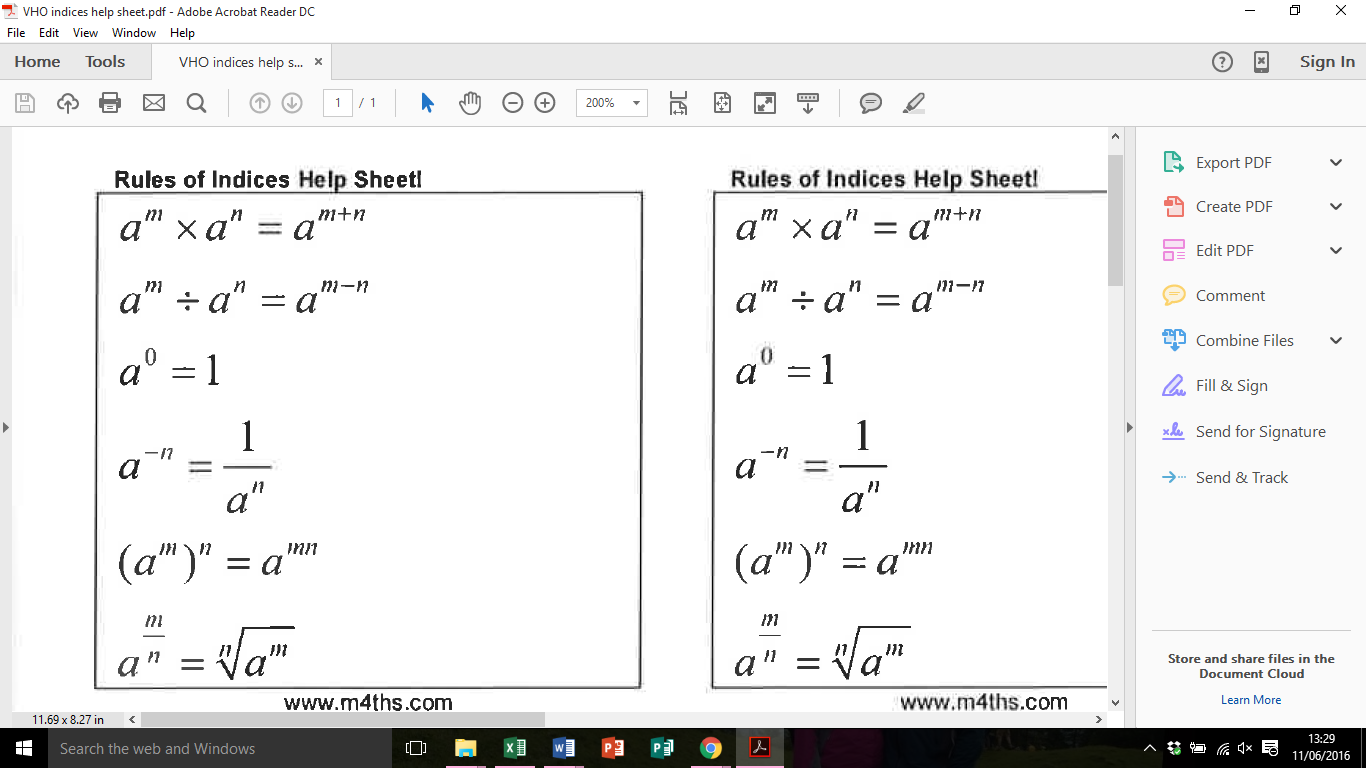
\(64^{\frac{1}{3}} = \sqrt[3]{64} = 4\), since \(4^{3} = 64\).
So \(64^{-\frac{1}{3}} = \frac{1}{4}\).
Answer: \(\frac{1}{4}\)
Estimating Calculations
6 questions
Things to remember
Round each number to one significant figure first – this earns you one mark.
Don’t forget to use the correct order of operations.
1.3 marksWork out an estimate for \(\frac{3.1 \times 9.87}{0.509}\)
Worked solution
Round each value to 1 significant figure: \(3.1 \approx 3\), \(9.87 \approx 10\), \(0.509 \approx 0.5\).
The estimate becomes \(\dfrac{3 \times 10}{0.5}\).
Numerator: \(3 \times 10 = 30\).
Divide: \(30 \div 0.5 = 60\).
Answer: \(60\)
2.3 marksMargaret has some goats.
The goats produce an average total of 21.7 litres of milk per day for 280 days.
Margaret sells the milk in \(\frac{1}{2}\) litre bottles.
Work out an estimate for the total number of bottles that Margaret will be able to fill with the milk.
You must show clearly how you got your estimate.
Worked solution
Round each value to 1 significant figure: \(21.7 \approx 20\), \(280 \approx 300\).
Estimate the total milk: \(20 \times 300 = 6000\) litres.
Each bottle holds \(\frac{1}{2}\) litre, so divide by \(0.5\): \(6000 \div 0.5 = 12\,000\).
Answer: \(12\,000\) bottles
3.2 marksWork out an estimate for the value of \(\frac{89.3 \times 0.51}{4.8}\)
Worked solution
Round each value to 1 significant figure: \(89.3 \approx 90\), \(0.51 \approx 0.5\), \(4.8 \approx 5\).
The estimate becomes \(\dfrac{90 \times 0.5}{5} = \dfrac{45}{5} = 9\).
Answer: \(9\)
4.3 marksWork out an estimate for \(\sqrt{1.98 + 2.16 \times 7.35}\)
Worked solution
Round each value to 1 significant figure: \(1.98 \approx 2\), \(2.16 \approx 2\), \(7.35 \approx 7\).
5.3 marksA ticket for a seat at a school play costs £2.95
There are 21 rows of seats.
There are 39 seats in each row.
The school will sell all the tickets.
Work out an estimate for the total money the school will get.
Worked solution
Round each value to 1 significant figure: \(£2.95 \approx £3\), \(21 \approx 20\), \(39 \approx 40\).
Total number of seats: \(20 \times 40 = 800\).
Total money: \(800 \times £3 = £2400\).
Answer: \(£2400\)
6.1 markJayne writes down the following
3.4 × 5.3 = 180.2
Without doing the exact calculation, explain why Jayne’s answer cannot be correct.
Worked solution
Round to 1 significant figure: \(3.4 \approx 3\) and \(5.3 \approx 5\).
Estimate: \(3 \times 5 = 15\), so the answer should be approximately \(15\).
Jayne's answer of \(180.2\) is far too large and cannot be correct.
Answer: The answer should be approximately \(15\) (since \(3 \times 5 = 15\)), so \(180.2\) is much too large.
Bounds
6 questions
Things to remember
Calculating bounds is the opposite of rounding – they are the limits at which you would round up instead of down, and vice versa.
1.2 marks
A piece of wood has a length of 65 centimetres to the nearest centimetre.
(a)
What is the least possible length of the piece of wood?
(b)
What is the greatest possible length of the piece of wood?
Worked solution
(a)
The length is 65 cm to the nearest centimetre, so the degree of accuracy is 1 cm.
Lower bound = 65 - 0.5 = 64.5 cm.
Answer: 64.5 cm
(b)
Upper bound = 65 + 0.5 = 65.5 cm.
Note: the greatest possible length is just below 65.5 cm (since any value of exactly 65.5 would round to 66). The upper bound is 65.5 cm (strict).
Answer: 65.5 cm
2.2 marks
Chelsea's height is 168 cm to the nearest cm.
(a)
What is Chelsea's minimum possible height?
(b)
What is Chelsea's maximum possible height?
Worked solution
(a)
Chelsea's height is 168 cm to the nearest cm, so the degree of accuracy is 1 cm.
Lower bound = 168 - 0.5 = 167.5 cm.
Answer: 167.5 cm
(b)
Upper bound = 168 + 0.5 = 168.5 cm.
The maximum possible height is just below 168.5 cm (strict upper bound).
Answer: 168.5 cm
3.3 marks
Dionne has 60 golf balls.
Each of these golf balls weighs 42 grams to the nearest gram.
Work out the greatest possible total weight of all 60 golf balls.
Give your answer in kilograms.
Worked solution
Each golf ball weighs 42 g to the nearest gram, so the degree of accuracy is 1 g.
Upper bound for one golf ball = 42 + 0.5 = 42.5 g.
For the greatest possible total weight, use the upper bound for each ball: greatest total weight = 60 \times 42.5 = 2550 g.
Convert to kilograms: 2550 \div 1000 = 2.55 kg.
Answer: 2.55 kg
4.2 marks
The length, \(L\) cm, of a line is measured as 13 cm correct to the nearest centimetre.
Complete the following statement to show the range of possible values of \(L\)
\(\text{..................} \le L < \text{..................}\)
Worked solution
The length is 13 cm correct to the nearest centimetre, so the degree of accuracy is 1 cm.
Lower bound = 13 - 0.5 = 12.5 cm (inclusive).
Upper bound = 13 + 0.5 = 13.5 cm (strict).
The error interval is \(12.5 \le L < 13.5\).
Answer: \(12.5 \le L < 13.5\)
5.2 marks
Jim rounds a number, \(x\), to one decimal place.
The result is 7.2
Write down the error interval for \(x\).
Worked solution
The number \(x\) is rounded to one decimal place with a result of 7.2, so the degree of accuracy is 0.1.
Lower bound = 7.2 - 0.05 = 7.15 (inclusive).
Upper bound = 7.2 + 0.05 = 7.25 (strict).
The error interval is \(7.15 \le x < 7.25\).
Answer: \(7.15 \le x < 7.25\)
6.2 marks
A pencil has a length of 17 cm measured to the nearest centimetre.
(a)
Write down the least possible length of the pencil.
(b)
Write down the greatest possible length of the pencil.
Worked solution
(a)
The pencil is 17 cm to the nearest centimetre, so the degree of accuracy is 1 cm.
Lower bound = 17 - 0.5 = 16.5 cm.
Answer: 16.5 cm
(b)
Upper bound = 17 + 0.5 = 17.5 cm.
The greatest possible length is just below 17.5 cm (strict upper bound).
Answer: 17.5 cm
Expand and Factorise Quadratics
9 questions
Things to remember
Use FOIL or grid method to expand brackets.
For ax²+bx+c=0, find numbers with sum b and product ac to factorise.
1.2 marks
Expand and simplify \((m + 7)(m + 3)\)
Worked solution
Use FOIL to expand \((m + 7)(m + 3)\): First: \(m \times m = m^2\). Outer: \(m \times 3 = 3m\). Inner: \(7 \times m = 7m\). Last: \(7 \times 3 = 21\).
Collect all terms: \(m^2 + 3m + 7m + 21\).
Simplify by combining like terms: \(3m + 7m = 10m\).
Answer: \(m^2 + 10m + 21\)
2.4 marks(a)
Factorise \(6 + 9x\)
(b)
Factorise \(y^{2} - 16\)
(c)
Factorise \(2p^{2} - p - 10\)
Worked solution
(a)
Find the HCF of \(6\) and \(9x\). The HCF of the coefficients \(6\) and \(9\) is \(3\).
Divide each term by \(3\): \(6 \div 3 = 2\) and \(9x \div 3 = 3x\).
Answer: \(3(2 + 3x)\)
(b)
Recognise \(y^2 - 16\) as a difference of two squares (DOTS): \(y^2 - 4^2\).
Apply the identity \(a^2 - b^2 = (a - b)(a + b)\) with \(a = y\) and \(b = 4\).
Answer: \((y - 4)(y + 4)\)
(c)
Factorise \(2p^2 - p - 10\). Here \(a = 2\), \(b = -1\), \(c = -10\), so \(ac = 2 \times (-10) = -20\).
Find two numbers with sum \(b = -1\) and product \(ac = -20\). These are \(4\) and \(-5\) since \(4 + (-5) = -1\) and \(4 \times (-5) = -20\).
Split the middle term: \(2p^2 + 4p - 5p - 10\).
Factorise in pairs: \(2p(p + 2) - 5(p + 2)\).
Take out the common factor \((p + 2)\).
Answer: \((p + 2)(2p - 5)\)
3.3 marks
Solve, by factorising, the equation \(8x^{2} - 30x - 27 = 0\)
Use FOIL to expand \((m + 3)(m + 10)\): First: \(m \times m = m^2\). Outer: \(m \times 10 = 10m\). Inner: \(3 \times m = 3m\). Last: \(3 \times 10 = 30\).
Collect all terms: \(m^2 + 10m + 3m + 30\).
Simplify: \(10m + 3m = 13m\).
Answer: \(m^2 + 13m + 30\)
9.6 marks(a)
Factorise \(x^{2} + 7x\)
(b)
Factorise \(y^{2} - 10y + 16\)
(c) (i)
Factorise \(2t^{2} + 5t + 2\)
(ii)
\(t\) is a positive whole number. The expression \(2t^{2} + 5t + 2\) can never have a value that is a prime number. Explain why.
Worked solution
(a)
Find the HCF of \(x^2\) and \(7x\). Both terms contain a factor of \(x\), so the HCF is \(x\).
Divide each term by \(x\): \(x^2 \div x = x\) and \(7x \div x = 7\).
Answer: \(x(x + 7)\)
(b)
Factorise \(y^2 - 10y + 16\). Find two numbers with sum \(-10\) and product \(16\).
The numbers are \(-2\) and \(-8\) since \(-2 + (-8) = -10\) and \(-2 \times (-8) = 16\).
Answer: \((y - 2)(y - 8)\)
(c)(i)
Factorise \(2t^2 + 5t + 2\). Here \(a = 2\), \(b = 5\), \(c = 2\), so \(ac = 4\).
Find two numbers with sum \(5\) and product \(4\). These are \(1\) and \(4\) since \(1 + 4 = 5\) and \(1 \times 4 = 4\).
Split the middle term: \(2t^2 + t + 4t + 2\).
Factorise in pairs: \(t(2t + 1) + 2(2t + 1)\).
Take out the common factor \((2t + 1)\).
Answer: \((2t + 1)(t + 2)\)
(c)(ii)
From (c)(i), \(2t^2 + 5t + 2 = (2t + 1)(t + 2)\).
When \(t\) is a positive whole number: \(2t + 1 \geq 3\) and \(t + 2 \geq 3\).
So the expression is a product of two integers, each greater than \(1\).
A prime number has no factor pair other than \(1\) and itself, so the expression can never be prime.
Answer: Because \(2t^2 + 5t + 2 = (2t + 1)(t + 2)\), and for positive whole \(t\) both factors are greater than \(1\), the expression is always a product of two integers each \(> 1\), so it cannot be prime.
Rearranging Formulae
6 questions
Things to remember
Firstly decide what needs to be on its own.
Secondly move all terms containing that letter to one side.
Thirdly separate out the required letter on its own.
1.2 marks
Make \(u\) the subject of the formula
\[D = ut + kt^{2}\]
Worked solution
Start with \(D = ut + kt^{2}\).
Subtract \(kt^{2}\) from both sides: \(D - kt^{2} = ut\).
Divide both sides by \(t\): \(u = \dfrac{D - kt^{2}}{t}\).
Answer: \(u = \dfrac{D - kt^{2}}{t}\)
2.5 marks(a)
Solve \(4(x + 3) = 6\)
(b)
Make \(t\) the subject of the formula \(v = u + 5t\)
Worked solution
(a)
Start with \(4(x + 3) = 6\).
Divide both sides by \(4\): \(x + 3 = \dfrac{6}{4} = \dfrac{3}{2}\).
Subtract \(3\) from both sides: \(x = \dfrac{3}{2} - 3 = \dfrac{3}{2} - \dfrac{6}{2} = -\dfrac{3}{2}\).
Answer: \(x = -\dfrac{3}{2}\)
(b)
Start with \(v = u + 5t\).
Subtract \(u\) from both sides: \(v - u = 5t\).
Divide both sides by \(5\): \(t = \dfrac{v - u}{5}\).
Answer: \(t = \dfrac{v - u}{5}\)
3.5 marks(a)
Expand and simplify \((x - y)^{2}\)
(b)
Rearrange \(a(q - c) = d\) to make \(q\) the subject.
Worked solution
(a)
Expand \((x - y)^{2} = (x - y)(x - y)\).
Use FOIL: \(= x^{2} - xy - xy + y^{2}\).
Simplify: \(= x^{2} - 2xy + y^{2}\).
Answer: \(x^{2} - 2xy + y^{2}\)
(b)
Start with \(a(q - c) = d\).
Divide both sides by \(a\): \(q - c = \dfrac{d}{a}\).
Add \(c\) to both sides: \(q = \dfrac{d}{a} + c\).
Answer: \(q = \dfrac{d}{a} + c\)
4.4 marks
Make \(x\) the subject of
\[5(x - 3) = y(4 - 3x)\]
Worked solution
Start with \(5(x - 3) = y(4 - 3x)\).
Expand both sides: \(5x - 15 = 4y - 3xy\).
Collect all terms containing \(x\) on the left: \(5x + 3xy = 4y + 15\).
Factorise \(x\) out of the left-hand side: \(x(5 + 3y) = 4y + 15\).
Divide both sides by \((5 + 3y)\): \(x = \dfrac{4y + 15}{5 + 3y}\).
Answer: \(x = \dfrac{4y + 15}{5 + 3y}\)
5.4 marks
\[P = \frac{n^{2} + a}{n + a}\]
Rearrange the formula to make \(a\) the subject.
Worked solution
Start with \(P = \dfrac{n^{2} + a}{n + a}\).
Multiply both sides by \((n + a)\): \(P(n + a) = n^{2} + a\).
Expand the left-hand side: \(Pn + Pa = n^{2} + a\).
Collect all terms containing \(a\) on one side: \(Pa - a = n^{2} - Pn\).
Factorise \(a\) out of the left-hand side: \(a(P - 1) = n^{2} - Pn\).
Divide both sides by \((P - 1)\): \(a = \dfrac{n^{2} - Pn}{P - 1}\).
Answer: \(a = \dfrac{n^{2} - Pn}{P - 1}\)
6.4 marks
\[\frac{x}{x + c} = \frac{p}{q}\]
Make \(x\) the subject of the formula.
Worked solution
Start with \(\dfrac{x}{x + c} = \dfrac{p}{q}\).
Cross-multiply: \(qx = p(x + c)\).
Expand the right-hand side: \(qx = px + pc\).
Collect all terms containing \(x\) on one side: \(qx - px = pc\).
Factorise \(x\) out of the left-hand side: \(x(q - p) = pc\).
Divide both sides by \((q - p)\): \(x = \dfrac{pc}{q - p}\).
Answer: \(x = \dfrac{pc}{q - p}\)
Linear Simultaneous Equations
8 questions
Things to remember
Scale up (if necessary)
Add or subtract (to eliminate)
Solve (to find x)
Substitute (to find y)
1.5 marks
The Singh family and the Peterson family go to the cinema.
The Singh family buy 2 adult tickets and 3 child tickets. They pay \(\pounds 28.20\) for the tickets.
The Peterson family buy 3 adult tickets and 5 child tickets. They pay \(\pounds 44.75\) for the tickets.
Find the cost of each adult ticket and each child ticket.
Worked solution
Let \(a\) = cost of an adult ticket and \(c\) = cost of a child ticket.
Form equations: \(2a + 3c = 28.20\) \(\dots\) (1) and \(3a + 5c = 44.75\) \(\dots\) (2).
Subtract (3) from (4): \(7s = 420\), so \(s = 60\).
Substitute \(s = 60\) into (2): \(180 + 2l = 530\), so \(2l = 350\), giving \(l = 175\).
Answer: Small box = 60 paper clips, Large box = 175 paper clips
Graphical Inequalities
5 questions
Things to remember
Use a table of values to draw the linear graphs.
Solid line for ≥/≤, dotted for >/<.
Test (0,0) to find which side to shade.
1.4 marks(a)
Solve the inequality \(5e + 3 > e + 12\)
(2)
(b)
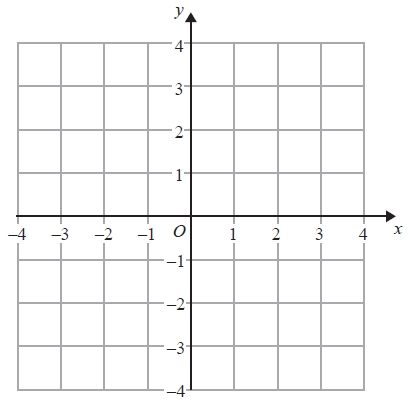
On the grid, shade the region defined by the inequality \(x + y > 1\)
(2)
Worked solution
(a)
Start with \(5e + 3 > e + 12\).
Subtract \(e\) from both sides: \(4e + 3 > 12\).
Subtract \(3\) from both sides: \(4e > 9\).
Divide both sides by \(4\): \(e > 2.25\).
Answer: \(e > 2.25\)
(b)
Draw the boundary line \(x + y = 1\). Rearrange to \(y = 1 - x\). When \(x = 0\), \(y = 1\); when \(x = 1\), \(y = 0\).
Since the inequality is strict (\(>\)), draw a **dashed** line through \((0, 1)\) and \((1, 0)\).
Test the origin \((0, 0)\): \(0 + 0 = 0\), and \(0 > 1\) is **false**, so the origin is **not** in the required region.
Shade the region **above** the dashed line (the side that does not contain the origin). This is the region where \(x + y > 1\).
Answer: Dashed line through \((0,1)\) and \((1,0)\); shade the region above and to the right of the line (the side not containing the origin).
2.3 marks
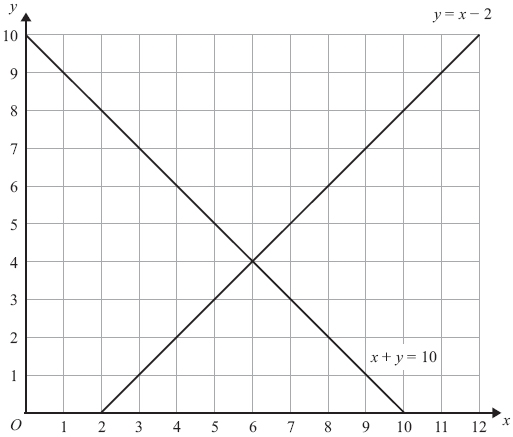
The lines \(y = x - 2\) and \(x + y = 10\) are drawn on the grid.
On the grid, mark with a cross (×) each of the points with integer coordinates that are in the region defined by
\(y > x - 2\) \(x + y < 10\) \(x > 3\)
Worked solution
Identify the three inequalities that define the region: \(y > x - 2\), \(x + y < 10\), and \(x > 3\).
For \(y > x - 2\): points must lie **above** the line \(y = x - 2\) (dashed, strict).
For \(x + y < 10\): points must lie **below** the line \(x + y = 10\) (dashed, strict).
For \(x > 3\): points must have \(x\)-coordinate strictly greater than \(3\), so \(x \ge 4\) for integers.
The two given lines intersect where \(y = x - 2\) and \(x + y = 10\). Substituting: \(x + (x - 2) = 10\), so \(2x = 12\), \(x = 6\), \(y = 4\). The lines meet at \((6, 4)\).
Systematically find integer points with \(x \ge 4\) satisfying both \(y > x - 2\) and \(x + y < 10\) (i.e. \(x - 2 < y < 10 - x\)):
Draw the boundary line \(x + y = 6\). When \(x = 0\), \(y = 6\); when \(x = 6\), \(y = 0\). Since the inequality is strict (\(<\)), draw a **dashed** line. Test origin: \(0 + 0 = 0 < 6\) is **true**, so shade the side containing the origin (below the line).
Draw the boundary line \(x = -1\). This is a vertical line through \(x = -1\). Since the inequality is strict (\(>\)), draw a **dashed** line. The region is to the **right** of this line.
Draw the boundary line \(y = 2\). This is a horizontal line through \(y = 2\). Since the inequality is strict (\(>\)), draw a **dashed** line. The region is **above** this line.
The region R is the triangular area bounded by all three dashed lines: to the right of \(x = -1\), above \(y = 2\), and below \(x + y = 6\).
The vertices of the triangular region are at \((-1, 2)\), \((-1, 7)\), and \((4, 2)\), though all boundaries are excluded (dashed).
Shade this triangular region and label it R.
Answer: Three dashed lines: \(x + y = 6\), \(x = -1\), and \(y = 2\). The region R is the triangle to the right of \(x = -1\), above \(y = 2\), and below \(x + y = 6\).
4.6 marks(a)
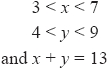
Given that \(x\) and \(y\) are integers such that
\(3 < x < 7\) \(4 < y < 9\) and \(x + y = 13\)
find all the possible values of \(x\).
(2)
(b)
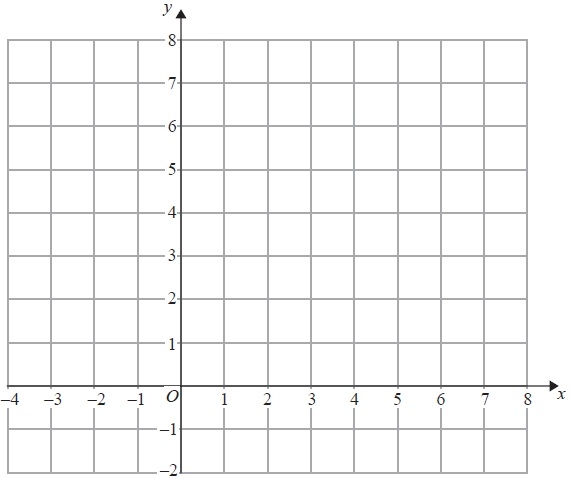
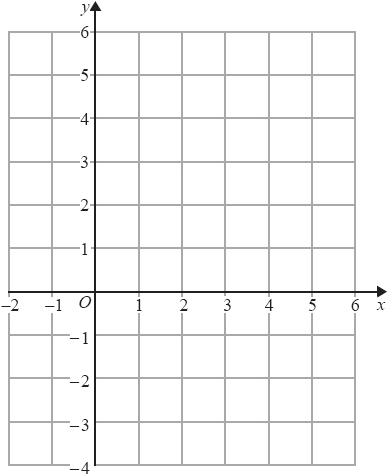
On the grid below show, by shading, the region defined by the inequalities
\(x\) and \(y\) are integers with \(3 < x < 7\) and \(4 < y < 9\) and \(x + y = 13\).
From \(3 < x < 7\), the integer values of \(x\) are \(4, 5, 6\).
From \(4 < y < 9\), the integer values of \(y\) are \(5, 6, 7, 8\).
Since \(x + y = 13\), substitute each \(x\): \(x = 4 \Rightarrow y = 9\) (not valid, \(y < 9\)); \(x = 5 \Rightarrow y = 8\) (valid); \(x = 6 \Rightarrow y = 7\) (valid).
Answer: \(x = 5\) and \(x = 6\)
(b)
Draw the boundary line \(y = -1\). This is a horizontal line through \(y = -1\). Since the inequality is \(\ge\), draw a **solid** line. The region is **on or above** this line.
Draw the boundary line \(y = 4 - x\) (i.e. \(x + y = 4\)). When \(x = 0\), \(y = 4\); when \(x = 4\), \(y = 0\). Since the inequality is \(\le\), draw a **solid** line. Test origin: \(0 \le 4 - 0 = 4\) is **true**, so shade the side containing the origin (below/on the line).
Draw the boundary line \(y = 3x - 1\). When \(x = 0\), \(y = -1\); when \(x = 1\), \(y = 2\). Since the inequality is \(\le\), draw a **solid** line. Test origin: \(0 \le 3(0) - 1 = -1\) is **false**, so shade the side **not** containing the origin (below/on the line).
The region R is bounded by all three solid lines: on or above \(y = -1\), on or below \(y = 4 - x\), and on or below \(y = 3x - 1\).
Shade this triangular region (including the boundaries) and label it R.
Answer: Three solid lines: \(y = -1\), \(y = 4 - x\), and \(y = 3x - 1\). The region R is the triangle with vertices at \((0, -1)\), \((5, -1)\), and \((1.25, 2.75)\), with all boundaries included.
5.4 marks
On the grid show, by shading, the region that satisfies all three of the inequalities
Draw the boundary line \(x + y = 7\). When \(x = 0\), \(y = 7\); when \(x = 7\), \(y = 0\). Since the inequality is strict (\(<\)), draw a **dashed** line. Test origin: \(0 + 0 = 0 < 7\) is **true**, so shade the side containing the origin (below the line).
Draw the boundary line \(y = 2x\). When \(x = 0\), \(y = 0\); when \(x = 2\), \(y = 4\). Since the inequality is strict (\(<\)), draw a **dashed** line. Test the point \((1, 0)\) (not on the line): \(0 < 2(1) = 2\) is **true**, so shade the side containing \((1,0)\) — **below** the line. (Note: the origin lies on this line so cannot be used as a test point.)
Draw the boundary line \(y = 3\). This is a horizontal line through \(y = 3\). Since the inequality is strict (\(>\)), draw a **dashed** line. The region is **above** this line.
The region R is bounded by all three dashed lines: below \(x + y = 7\), below \(y = 2x\), and above \(y = 3\).
Find the vertices: \(y = 3\) meets \(y = 2x\) when \(3 = 2x\), so \(x = 1.5\) → point \((1.5, 3)\). \(y = 3\) meets \(x + y = 7\) when \(x + 3 = 7\), so \(x = 4\) → point \((4, 3)\). \(y = 2x\) meets \(x + y = 7\) when \(x + 2x = 7\), so \(x = \frac{7}{3}\), \(y = \frac{14}{3}\) → point \((2.\overline{3}, 4.\overline{6})\).
Shade the triangular region enclosed by these three dashed lines and label it R.
Answer: Three dashed lines: \(x + y = 7\), \(y = 2x\), and \(y = 3\). The region R is the triangle with vertices approximately at \((1.5, 3)\), \((4, 3)\), and \((2.\overline{3}, 4.\overline{6})\), with all boundaries excluded.
Angles in parallel lines and polygons
9 questions
Things to remember
Angles in triangle 180\(^\circ\)
Straight line 180\(^\circ\)
Around a point 360\(^\circ\)
Vertically opposite equal
Alternate equal
Corresponding equal
Supplementary 180\(^\circ\)
Exterior+interior=180\(^\circ\)
Exterior=360\(^\circ\)\(\div n\)
1.4 marksPQ is a straight line.
[Diagram: A triangle is drawn above the straight line PQ. The vertex of the triangle is at the top. At the base left where the triangle meets line PQ, the angle inside the triangle is labelled x degrees. At the base right where the triangle meets line PQ, the angle inside the triangle is labelled y degrees. At the top vertex, the angle inside the triangle is labelled 40 degrees. Diagram NOT accurately drawn.]
Worked solution
a
The angle between line PQ going left (towards P) and the left side of the triangle is \(75°\).
Angles on a straight line sum to \(180°\): \(x + 75 = 180\).
\(x = 180 - 75 = 105\).
Answer: \(x = 105°\)
b(i)
Angles in a triangle sum to \(180°\): \(40 + 105 + y = 180\).
\(y = 180 - 40 - 105 = 35\).
Answer: \(y = 35°\)
b(ii)
Angles on a straight line sum to \(180°\) (used to find \(x = 180 - 75 = 105°\)).
Angles in a triangle sum to \(180°\) (used to find \(y = 180 - 40 - 105 = 35°\)).
Answer: Angles on a straight line sum to \(180°\); angles in a triangle sum to \(180°\).
2.5 marks
Worked solution
a
BCD is a straight line, so angles on a straight line sum to \(180°\).
Angle ACB \(= 180 - 62 = 118°\).
Triangle ABC is isosceles with \(AC = BC\), so the base angles are equal: angle BAC = angle ABC = \(x\).
Angles in a triangle sum to \(180°\): \(x + x + 118 = 180\).
The angle \(x\) is an interior angle of the regular octagon.
Answer: \(x = 135°\)
3.2 marks[Diagram: A regular pentagon is shown. Diagram NOT accurately drawn.]
Worked solution
a
A regular pentagon has \(n = 5\) sides.
Exterior angle of a regular polygon \(= \dfrac{360}{n}\).
Exterior angle \(= \dfrac{360}{5} = 72°\).
Answer: \(72°\)
4.4 marksABCD is a quadrilateral.
[Diagram: A quadrilateral ABCD is shown. The angles at A, B, C, and D are expressed in terms of an unknown. The angles are labelled as follows: angle A = x\(^\circ\), angle B = (x + 10)\(^\circ\), angle C = (x + 20)\(^\circ\), angle D = (x + 30)\(^\circ\). Diagram NOT accurately drawn.]
Work out the size of the largest angle in the quadrilateral.
Worked solution
Angles in a quadrilateral sum to \(360°\).
\(x + (x + 10) + (x + 20) + (x + 30) = 360\).
\(4x + 60 = 360\).
\(4x = 300\), so \(x = 75\).
The four angles are \(75°\), \(85°\), \(95°\), and \(105°\).
The largest angle is \(x + 30 = 75 + 30 = 105°\).
Answer: \(105°\)
5.2 marks[Diagram: A regular hexagon is shown. Diagram NOT accurately drawn.]
Calculate the size of the exterior angle of a regular hexagon.
Worked solution
A regular hexagon has \(n = 6\) sides.
Exterior angle of a regular polygon \(= \dfrac{360}{n}\).
Exterior angle \(= \dfrac{360}{6} = 60°\).
Answer: \(60°\)
6.1 markDE is parallel to FG.
[Diagram: Two parallel lines DE and FG are shown, with D on the left and E on the right for the top line, and F on the left and G on the right for the bottom line. A transversal crosses both lines. At the intersection with DE, the angle on the left side is labelled 47\(^\circ\). At the intersection with FG, the angle on the left side is labelled 64\(^\circ\). The angle marked y\(^\circ\) is between the two parallel lines where the two transversal segments meet at a point. Diagram NOT accurately drawn.]
Find the size of the angle marked \(y^\circ\).
Worked solution
DE is parallel to FG. Two line segments meet at a point between the parallel lines, forming the angle \(y°\).
Draw an imaginary line through the meeting point, parallel to DE and FG.
By alternate angles with DE, the upper part of \(y = 47°\).
By alternate angles with FG, the lower part of \(y = 64°\).
\(y = 47 + 64 = 111\).
Answer: \(y = 111°\)
7.4 marksBEG and CFG are straight lines.
ABC is parallel to DEF.
Angle ABE = 48\(^\circ\).
Angle BCF = 30\(^\circ\).
[Diagram: Two parallel lines ABC (top) and DEF (bottom) are shown. Line BEG passes through B on the top line and E on the bottom line, continuing to G. Line CFG passes through C on the top line and F on the bottom line, continuing to G. Angle ABE (at B, between BA and BE) is 48\(^\circ\). Angle BCF (at C, between BC and CF) is 30\(^\circ\). Angle x is at E on line DEF. Angle y is at the point G where the two lines meet. Diagram NOT accurately drawn.]
Worked solution
a(i)
ABC is parallel to DEF and BEG is a transversal cutting both parallel lines.
Angle ABE \(= 48°\) and angle DEB \(= x\) are alternate angles.
Alternate angles are equal, so \(x = 48°\).
Answer: \(x = 48°\)
a(ii)
Answer: Alternate angles are equal (between parallel lines ABC and DEF, cut by transversal BEG).
b(i)
BEG and CFG are straight lines meeting at G. Consider triangle BCG.
Angle ABG \(= 48°\) is an exterior angle of triangle BCG at vertex B (since A--B--C is a straight line).
Angle BCG \(= 30°\) (angle BCF \(= 30°\), and F is on line CG so angle BCG \(= 30°\)).
By the exterior angle theorem: exterior angle \(=\) sum of the two opposite interior angles.
\(48 = 30 + y\), so \(y = 18\).
Answer: \(y = 18°\)
b(ii)
Answer: Exterior angle of a triangle equals the sum of the two opposite interior angles (or equivalently: angles in a triangle sum to \(180°\)).
8.3 marksThe diagram shows the position of each of three buildings in a town.
The bearing of the Hospital from the Art gallery is 072\(^\circ\).
The Cinema is due East of the Hospital.
The distance from the Hospital to the Art gallery is equal to the distance from the Hospital to the Cinema.
[Diagram: Three points are shown representing the Art gallery (bottom-left), Hospital (top-centre), and Cinema (right, level with Hospital). A North arrow is shown at the Hospital. The line from Art gallery to Hospital makes an angle of 072\(^\circ\) measured clockwise from North at the Art gallery. The Cinema is directly to the right of the Hospital (due East). The distances from Hospital to Art gallery and from Hospital to Cinema are equal. Diagram NOT accurately drawn.]
Work out the bearing of the Cinema from the Art gallery.
Worked solution
Let A = Art gallery, H = Hospital, C = Cinema.
The bearing of H from A is \(072°\). North lines are parallel, so the bearing of A from H \(= 072 + 180 = 252°\).
The Cinema is due East of the Hospital, so the bearing of C from H \(= 090°\).
Angle AHC \(= 252 - 090 = 162°\) (the angle at H between HA and HC, measured between their bearings).
Triangle AHC is isosceles with \(AH = HC\), so base angles are equal: angle HAC = angle HCA \(= \dfrac{180 - 162}{2} = \dfrac{18}{2} = 9°\).
The bearing of C from A \(=\) bearing of H from A \(+\) angle HAC \(= 072 + 9 = 081°\).
C is to the right of the line AH (further east), confirming we add the \(9°\).
Answer: \(081°\)
9.3 marks[Diagram: Three points A (bottom-left), P (top-centre), and B (far right, lower than P) are shown. A North arrow is shown at P. The bearing from P to A is 210\(^\circ\) (i.e. the angle measured clockwise from North at P to the line PA is 210\(^\circ\)). The bearing from P to B is 126\(^\circ\) (i.e. the angle measured clockwise from North at P to the line PB is 126\(^\circ\)). Diagram NOT accurately drawn.]
Work out the bearing of
Worked solution
i
The bearing of B from P is the angle measured clockwise from North at P to the line PB.
From the diagram, this bearing is given as \(126°\).
Answer: \(126°\)
ii
The bearing of A from P is \(210°\).
To find the bearing of P from A, use the back-bearing rule: add or subtract \(180°\).
\(210 - 180 = 030°\).
Since \(210° > 180°\), we subtract \(180°\) to get the back bearing.
Answer: \(030°\)
Loci and Construction
7 questions
Things to remember
Question will say 'use ruler and compasses'
Some marks for almost-right attempts
Bisector means 'cut in half'
1.2 marks
A horizontal line segment AB is drawn, with point A on the left and point B on the right.
Use ruler and compasses to construct the perpendicular bisector of the line segment AB.
You must show all your construction lines.
Worked solution
Set your compasses to more than half the length of AB.
Place the compass point on A and draw arcs above and below the line.
Keeping the compass width the same, place the compass point on B and draw arcs above and below the line so that they cross the first pair of arcs.
Using a ruler, draw a straight line through the two points where the arcs intersect. This line is the perpendicular bisector of AB.
Answer: A straight line through the two arc intersection points, crossing AB at its midpoint at 90°.
2.3 marks
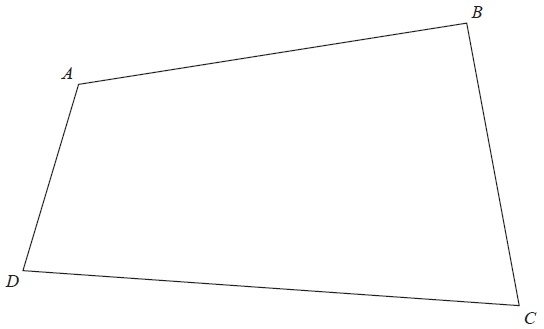
The diagram shows the plan of a park. The park is an irregular quadrilateral with vertices D (bottom-left), A (top-left), B (top-right) and C (bottom-right). Scale: 1 cm represents 100 m.
A fountain in the park is equidistant from A and from C. The fountain is exactly 700 m from D.
On the diagram, mark the position of the fountain with a cross (×).
Worked solution
The fountain is equidistant from A and C, so it lies on the perpendicular bisector of AC. Construct this bisector: set compasses to more than half the length of AC, draw arcs from A and from C (both above and below AC), and join the two intersection points with a straight line.
The fountain is exactly 700 m from D. Using the scale 1 cm = 100 m, 700 m corresponds to 7 cm. Set compasses to 7 cm, place the point on D, and draw an arc.
The fountain is at the point where the perpendicular bisector of AC meets the arc of radius 7 cm from D. Mark this intersection with a cross (×).
Answer: A cross (×) at the intersection of the perpendicular bisector of AC and the circle of radius 7 cm centred on D.
3.3 marks
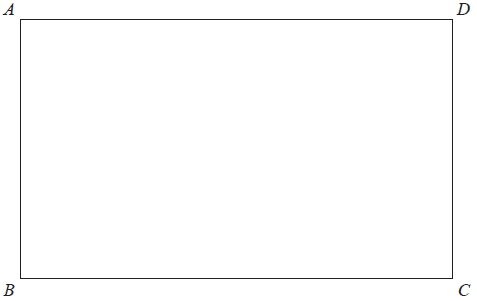
Here is a scale drawing of an office. The scale is 1 cm to 2 metres. The office is a rectangle with vertices labelled A (top-left), D (top-right), C (bottom-right) and B (bottom-left).
A photocopier is going to be put in the office.
The photocopier has to be closer to B than it is to A.
The photocopier also has to be less than 5 metres from C.
Show, by shading, the region where the photocopier can be put.
Worked solution
The photocopier must be closer to B than to A, so it must be on B's side of the perpendicular bisector of AB. Construct the perpendicular bisector of AB: set compasses to more than half the length of AB, draw arcs from A and B, and draw the bisector line through the arc intersections.
The photocopier must be less than 5 metres from C. Using the scale 1 cm = 2 m, 5 m corresponds to 2.5 cm. Set compasses to 2.5 cm, place the point on C, and draw a circle (or arc).
Shade the region that is both on B's side of the perpendicular bisector of AB and inside the circle of radius 2.5 cm centred on C.
Answer: The shaded region is the overlap of the half-plane closer to B (below the perpendicular bisector of AB) and the interior of the circle of radius 2.5 cm centred on C.
4.2 marks
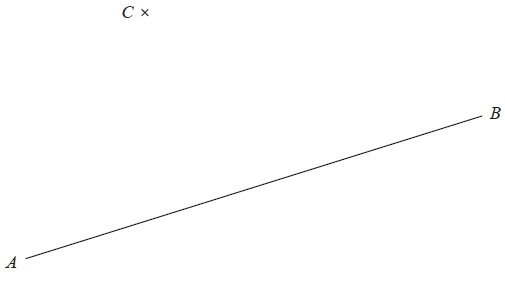
A line segment AB is drawn, sloping from point A at the bottom-left to point B at the upper-right. Point C is marked above and to the left of the line, away from it.
Use ruler and compasses to construct the perpendicular from point C to the line AB.
You must show all your construction lines.
Worked solution
Place the compass point on C. Open the compasses wide enough so that when you draw an arc, it crosses the line AB in two places. Draw this arc to create two intersection points on AB (call them P and Q).
Now construct the perpendicular bisector of the segment PQ: set compasses to more than half of PQ, draw arcs from P and from Q on both sides of the line.
Draw a straight line through C and the intersection point of the arcs (on the opposite side of AB from C). This line is perpendicular to AB and passes through C.
Answer: A straight line from C meeting AB at 90°, with all construction arcs shown.
5.3 marks
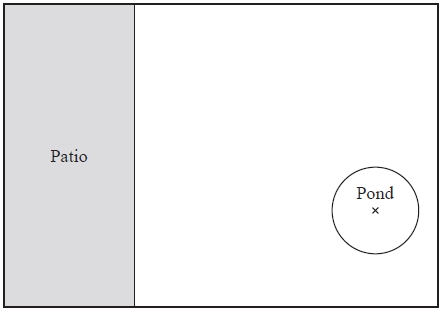
The diagram shows a garden in the shape of a rectangle. The scale of the diagram is 1 cm represents 2 m. Inside the rectangle, a region labelled "Patio" is shown on the left side, and a point labelled "Pond" is marked with a cross (×) on the right side.
Irfan is going to plant a tree in the garden.
The tree must be:
more than 3 metres from the patio
and more than 6 metres from the centre of the pond.
On the diagram, shade the region where Irfan can plant the tree.
Worked solution
The tree must be more than 3 metres from the patio. Using the scale 1 cm = 2 m, 3 m corresponds to 1.5 cm. Draw a line parallel to the right-hand edge of the patio, 1.5 cm to the right of it (inside the garden). The valid region is to the right of this line (further from the patio).
The tree must be more than 6 metres from the centre of the pond. Using the scale 1 cm = 2 m, 6 m corresponds to 3 cm. Set compasses to 3 cm, place the point on the pond (×), and draw a circle.
Shade the region that is both more than 1.5 cm from the patio edge and outside the circle of radius 3 cm from the pond, staying within the garden boundary.
Answer: The shaded region is the part of the garden that is more than 1.5 cm from the patio and outside the circle of radius 3 cm centred on the pond.
6.3 marks
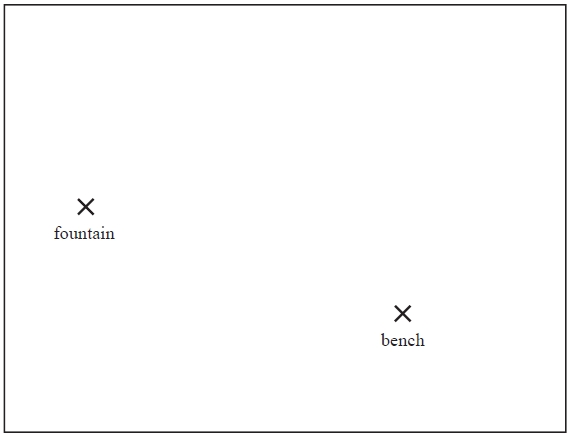
The diagram shows a scale drawing of a garden in the shape of a rectangle. Scale: 1 centimetre represents 2 metres. Inside the garden, a point labelled "fountain" is marked with a cross (×) towards the upper-left area, and a point labelled "bench" is marked with a cross (×) towards the lower-right area.
Haavi is going to plant a tree in the garden.
The tree must be:
less than 7 metres from the fountain,
less than 12 metres from the bench.
On the diagram show, by shading, the region in which Haavi can plant the tree.
Worked solution
The tree must be less than 7 metres from the fountain. Using the scale 1 cm = 2 m, 7 m corresponds to 3.5 cm. Set compasses to 3.5 cm, place the point on the fountain (×), and draw a circle.
The tree must be less than 12 metres from the bench. Using the scale 1 cm = 2 m, 12 m corresponds to 6 cm. Set compasses to 6 cm, place the point on the bench (×), and draw a circle.
Shade the region that is inside both circles (the overlap/intersection of the two circles), remaining within the garden boundary.
Answer: The shaded region is the intersection of the circle of radius 3.5 cm centred on the fountain and the circle of radius 6 cm centred on the bench, within the garden.
7.3 marks
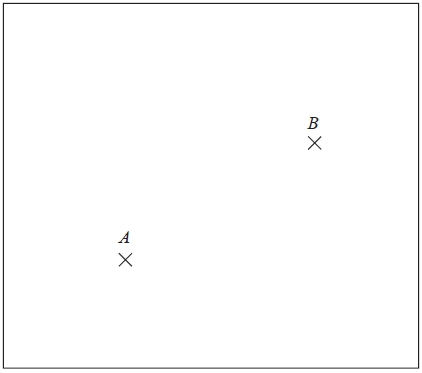
The diagram shows the positions of two shops, A and B, on a map. The map is a large square region. Point A is marked with a cross (×) towards the lower-left area, and point B is marked with a cross (×) towards the upper-right area.
The scale of the map is 1 cm represents 5 km.
Yannis wants to build a warehouse.
The warehouse needs to be:
less than 30 km from A,
less than 20 km from B.
Show by shading where Yannis can build the warehouse.
Worked solution
The warehouse must be less than 30 km from A. Using the scale 1 cm = 5 km, 30 km corresponds to 6 cm. Set compasses to 6 cm, place the point on A (×), and draw a circle.
The warehouse must be less than 20 km from B. Using the scale 1 cm = 5 km, 20 km corresponds to 4 cm. Set compasses to 4 cm, place the point on B (×), and draw a circle.
Shade the region that is inside both circles (the overlap/intersection of the two circles).
Answer: The shaded region is the intersection of the circle of radius 6 cm centred on A and the circle of radius 4 cm centred on B.
Transformations
7 questions
Things to remember
Reflection – flipped in mirror line
Rotation – turned degrees around centre
Translation – moved by vector
Enlargement – scale factor from centre
1.4 marks
The diagram shows shape P drawn on a coordinate grid. The grid has axes from \(-5\) to \(5\) on both the \(x\)-axis and \(y\)-axis. The origin is labelled O. Shape P is a pentagon (arrow shape) with vertices approximately at \((1, -1)\), \((3, -1)\), \((3, 1)\), \((4, 0)\) and \((1, 1)\), shaded grey.
(a)
On the grid, rotate the shaded shape P one quarter turn anticlockwise about O. Label the new shape Q.
(b)
On the grid, translate the shaded shape P by 2 units to the right and 3 units up. Label the new shape R.
Worked solution
(a)
To rotate 90° anticlockwise (one quarter turn) about the origin O, use the rule \((x, y) \to (-y, x)\).
Answer: Shape R with vertices at \((3, 4)\), \((5, 4)\), \((6, 3)\), \((5, 2)\) and \((3, 2)\), drawn on the grid.
2.6 marks
Triangle T has been drawn on a coordinate grid. The grid has axes from \(-7\) to \(7\) on the \(x\)-axis and \(-5\) to \(7\) on the \(y\)-axis. The origin is labelled O. Triangle T is a right-angled triangle with vertices approximately at \((1, 1)\), \((3, 1)\) and \((1, 5)\), shaded grey.
(a)
Reflect triangle T in the \(y\)-axis. Label the new triangle A.
(b)
Rotate triangle T by a half turn, centre O. Label the new triangle B.
A second coordinate grid is shown with axes from \(0\) to \(12\) on the \(x\)-axis and \(0\) to \(13\) on the \(y\)-axis. Triangle T has vertices approximately at \((1, 1)\), \((5, 1)\) and \((1, 5)\), shaded grey. Triangle C has vertices approximately at \((5, 5)\), \((11, 5)\) and \((5, 11)\), drawn with dashed lines.
(c)
Describe fully the single transformation which maps triangle T onto triangle C.
Worked solution
(a)
To reflect in the \(y\)-axis, use the rule \((x, y) \to (-x, y)\).
Apply to each vertex of T: \((1, 1) \to (-1, 1)\), \((3, 1) \to (-3, 1)\), \((1, 5) \to (-1, 5)\).
Plot and join the new vertices to form triangle A.
Answer: Triangle A with vertices at \((-1, 1)\), \((-3, 1)\) and \((-1, 5)\), drawn on the grid.
(b)
A half turn is a rotation of \(180°\) about the origin. The rule is \((x, y) \to (-x, -y)\).
Apply to each vertex of T: \((1, 1) \to (-1, -1)\), \((3, 1) \to (-3, -1)\), \((1, 5) \to (-1, -5)\).
Plot and join the new vertices to form triangle B.
Answer: Triangle B with vertices at \((-1, -1)\), \((-3, -1)\) and \((-1, -5)\), drawn on the grid.
(c)
On the second grid, triangle T has vertices at \((1, 1)\), \((3, 1)\) and \((1, 3)\). Triangle C has vertices at \((3, 3)\), \((9, 3)\) and \((3, 9)\).
Compare side lengths: T has base \(= 2\) and height \(= 2\); C has base \(= 6\) and height \(= 6\). The scale factor is \(\dfrac{6}{2} = 3\).
To find the centre of enlargement, note that each vertex of C is 3 times the corresponding vertex of T measured from the origin: \(3 \times (1, 1) = (3, 3)\), \(3 \times (3, 1) = (9, 3)\), \(3 \times (1, 3) = (3, 9)\). So the centre is the origin \((0, 0)\).
Answer: Enlargement, scale factor \(3\), centre \((0,\, 0)\).
3.5 marks
Two coordinate grids are shown.
Top grid: The grid has axes from \(-7\) to \(7\) on the \(x\)-axis and \(-5\) to \(5\) on the \(y\)-axis. Triangle P is a right-angled triangle with vertices approximately at \((-5, -1)\), \((-1, -1)\) and \((-1, -3)\), shaded grey. A point X is marked at \((-1, 1)\).
(a)
Rotate triangle P \(180^\circ\) about the point \((-1, 1)\). Label the new triangle A.
(b)
Translate triangle P by the vector \(\begin{pmatrix}6\\1\end{pmatrix}\). Label the new triangle B.
Bottom grid: The grid has axes from \(-1\) to \(5\) on the \(x\)-axis and \(-1\) to \(4\) on the \(y\)-axis. The line \(y = x\) is drawn. Triangle Q is a right-angled triangle with vertices approximately at \((1, 0)\), \((4, 0)\) and \((4, 2)\), shaded grey.
(c)
Reflect triangle Q in the line \(y = x\). Label the new triangle C.
Worked solution
(a)
Under a \(180°\) rotation about the point \((-1, 1)\), the mapping rule is \((x, y) \to (2(-1) - x,\; 2(1) - y) = (-2 - x,\; 2 - y)\).
Apply to each vertex of P: \((-5, -1) \to (3, 3)\), \((-1, -1) \to (-1, 3)\), \((-1, -3) \to (-1, 5)\).
Plot and join the new vertices to form triangle A.
Answer: Triangle A with vertices at \((3, 3)\), \((-1, 3)\) and \((-1, 5)\), drawn on the grid.
(b)
Add the translation vector \(\begin{pmatrix}6\\1\end{pmatrix}\) to each vertex of P.
Plot and join the new vertices to form triangle B.
Answer: Triangle B with vertices at \((1, 0)\), \((5, 0)\) and \((5, -2)\), drawn on the grid.
(c)
To reflect in the line \(y = x\), use the rule \((x, y) \to (y, x)\) (swap the coordinates).
Apply to each vertex of Q: \((1, 0) \to (0, 1)\), \((4, 0) \to (0, 4)\), \((4, 2) \to (2, 4)\).
Plot and join the new vertices to form triangle C.
Answer: Triangle C with vertices at \((0, 1)\), \((0, 4)\) and \((2, 4)\), drawn on the grid.
4.5 marks
The diagram shows shapes A and B drawn on a coordinate grid. The grid has axes from \(-6\) to \(8\) on the \(x\)-axis and \(-4\) to \(5\) on the \(y\)-axis.
Shape A is an L-shape in the second quadrant with vertices approximately at \((-5, 1)\), \((-5, 5)\), \((-3, 5)\), \((-3, 3)\), \((-1, 3)\) and \((-1, 1)\).
Shape B is an L-shape below with vertices approximately at \((-3, -4)\), \((-3, -2)\), \((-1, -2)\), \((-1, -1)\), \((1, -1)\) and \((1, -4)\).
(a)
Reflect shape A in the \(y\) axis.
(b)
Describe fully the single transformation which takes shape A to shape B.
Worked solution
(a)
To reflect in the \(y\)-axis, use the rule \((x, y) \to (-x, y)\).
Plot and join the new vertices to form the reflected L-shape.
Answer: Reflected shape with vertices at \((5, 1)\), \((5, 5)\), \((3, 5)\), \((3, 3)\), \((1, 3)\) and \((1, 1)\), drawn on the grid.
(b)
Shapes A and B are congruent L-shapes, so the transformation must preserve size (reflection, rotation or translation).
Shape A is upright and shape B is the same L-shape inverted, indicating a rotation of \(180°\).
To find the centre of rotation, connect pairs of corresponding vertices and find the midpoints: midpoint of \((-5, 1)\) and \((1, -1)\) is \((-2, 0)\); midpoint of \((-1, 1)\) and \((-3, -1)\) is \((-2, 0)\). All midpoints coincide at \((-2, 0)\).
The diagram shows a shaded right-angled triangle drawn on a coordinate grid. The grid has axes from \(-6\) to \(8\) on the \(x\)-axis and \(-5\) to \(8\) on the \(y\)-axis. The origin is labelled O. The triangle has vertices approximately at \((-4, -2)\), \((-1, -2)\) and \((-1, 1)\), shaded grey.
Enlarge the shaded triangle by a scale factor 2, centre 0.
Worked solution
To enlarge by scale factor \(2\), centre \(O\) (the origin), multiply every coordinate by \(2\).
Apply to each vertex: \((-4, -2) \to (-8, -4)\), \((-1, -2) \to (-2, -4)\), \((-1, 1) \to (-2, 2)\).
Plot and join the new vertices to form the enlarged triangle.
Answer: Enlarged triangle with vertices at \((-8, -4)\), \((-2, -4)\) and \((-2, 2)\), drawn on the grid.
6.5 marks
The diagram shows triangle A drawn on a coordinate grid. The grid has axes from \(-5\) to \(5\) on the \(x\)-axis and \(-5\) to \(5\) on the \(y\)-axis. The origin is labelled O. Triangle A is a right-angled triangle with vertices approximately at \((1, 1)\), \((4, 1)\) and \((1, 4)\), shaded grey.
(a)
On the grid, rotate triangle A \(180^\circ\) about O. Label your new triangle B.
(b)
On the grid, enlarge triangle A by scale factor \(\frac{1}{2}\), centre O. Label your new triangle C.
Worked solution
(a)
A \(180°\) rotation about O uses the rule \((x, y) \to (-x, -y)\).
Apply to each vertex of A: \((1, 1) \to (-1, -1)\), \((4, 1) \to (-4, -1)\), \((1, 4) \to (-1, -4)\).
Plot and join the new vertices to form triangle B.
Answer: Triangle B with vertices at \((-1, -1)\), \((-4, -1)\) and \((-1, -4)\), drawn on the grid.
(b)
To enlarge by scale factor \(\tfrac{1}{2}\), centre O (the origin), multiply every coordinate by \(\tfrac{1}{2}\).
Apply to each vertex of A: \((1, 1) \to (0.5,\, 0.5)\), \((4, 1) \to (2,\, 0.5)\), \((1, 4) \to (0.5,\, 2)\).
Plot and join the new vertices to form triangle C. The new triangle is half the side length of A and positioned between A and the origin.
Answer: Triangle C with vertices at \((0.5,\, 0.5)\), \((2,\, 0.5)\) and \((0.5,\, 2)\), drawn on the grid.
7.3 marks
The diagram shows shapes P and Q drawn on a coordinate grid. The grid has axes from \(-6\) to \(6\) on the \(x\)-axis and \(-4\) to \(4\) on the \(y\)-axis.
Shape P is a parallelogram with vertices approximately at \((-5, -1)\), \((-3, -1)\), \((-2, -3)\) and \((-4, -3)\), shaded grey.
Shape Q is a parallelogram with vertices approximately at \((1, 1)\), \((5, 1)\), \((4, 3)\) and \((2, 3)\), shaded grey.
Describe fully the single transformation that will map shape P onto shape Q.
Worked solution
Shape P has vertices at \((-5, -1)\), \((-3, -1)\), \((-2, -3)\) and \((-4, -3)\). Shape Q has vertices at \((5, 1)\), \((3, 1)\), \((2, 3)\) and \((4, 3)\).
The shapes are congruent parallelograms (same side lengths), so the transformation preserves size.
Check for rotation: under \(180°\) rotation about the origin, \((x, y) \to (-x, -y)\). Apply to each vertex of P: \((-5, -1) \to (5, 1)\) \(\checkmark\), \((-3, -1) \to (3, 1)\) \(\checkmark\), \((-2, -3) \to (2, 3)\) \(\checkmark\), \((-4, -3) \to (4, 3)\) \(\checkmark\).
All image vertices match Q, confirming the transformation.
Answer: Rotation, \(180°\), centre the origin \((0,\, 0)\).
Pythagoras' Theorem
8 questions
Things to remember
a² + b² = c²
Square both sides
Add or subtract
Square root
Round correctly
1.5 marks
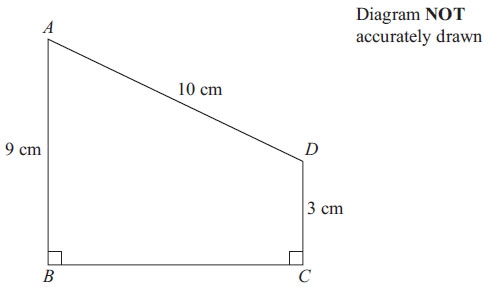
ABCD is a trapezium.
Diagram NOT accurately drawn
\(AD = 10\) cm \(AB = 9\) cm \(DC = 5\) cm Angle \(ABC\) = angle \(BCD\) = 90°
Calculate the length of \(AC\).
Give your answer correct to 3 significant figures.
Worked solution
Set up coordinates with \(B\) at the origin. Since angle \(ABC = 90°\) and angle \(BCD = 90°\), sides \(AB\) and \(DC\) are both perpendicular to \(BC\). Place \(B = (0,\,0)\), \(A = (0,\,9)\), \(C = (c,\,0)\) and \(D = (c,\,5)\).
Use \(AD = 10\) to find \(BC\). The distance \(AD = \sqrt{c^2 + (9-5)^2} = \sqrt{c^2 + 16} = 10\).
Square both sides: \(c^2 + 16 = 100\), so \(c^2 = 84\). Therefore \(BC = \sqrt{84}\).
Now find \(AC\). From \(A = (0,\,9)\) to \(C = (\sqrt{84},\,0)\): \(AC = \sqrt{84 + 81} = \sqrt{165}\).
\(\sqrt{165} = 12.8452...\)
Answer: \(AC = 12.8\) cm (3 s.f.)
2.3 marks
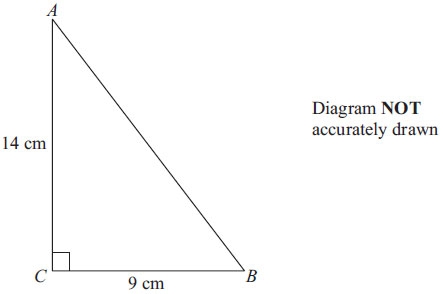
Diagram NOT accurately drawn
Calculate the length of \(AB\).
Give your answer correct to 1 decimal place.
Worked solution
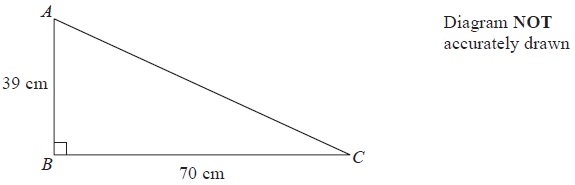
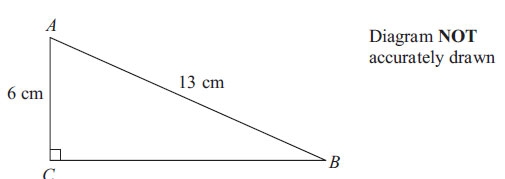
The right angle is at \(B\), so \(AC = 14\) cm is the hypotenuse and \(BC = 9\) cm is one of the shorter sides.
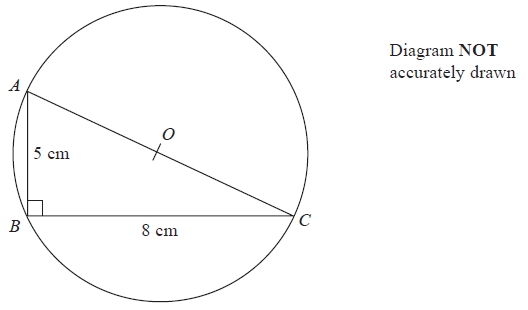
\(AC = \sqrt{89}\). This is the diameter of the circle.
Circumference \(= \pi \times d = \pi \sqrt{89} = 29.6088...\)
Answer: \(29.6\) cm (3 s.f.)
Trigonometry – SOH CAH TOA
7 questions
Things to remember
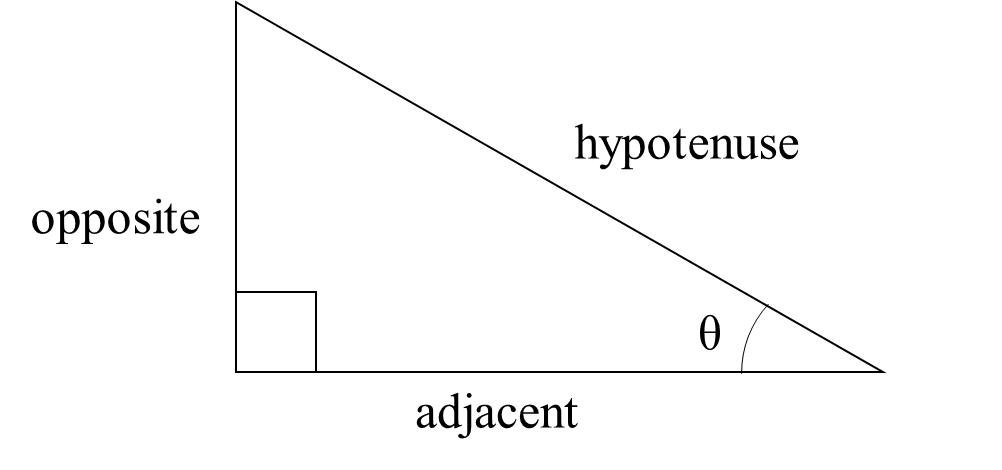
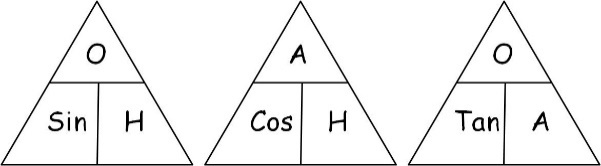
Label sides O, H, A
Choose SOH/CAH/TOA
Cover the one you need
Write equation
Solve
1.3 marks
The diagram shows triangle ABC.
BC = 8.5 cm. Angle ABC = 90°. Angle ACB = 38°.
Work out the length of AB.
Give your answer correct to 3 significant figures.
[Diagram NOT accurately drawn]
Worked solution
Label the sides relative to angle \(ACB = 38°\). The right angle is at \(B\), so \(AC\) is the hypotenuse. \(BC = 8.5\) cm is the side adjacent to the 38° angle, and \(AB\) is the side opposite the 38° angle.
Label the sides relative to angle \(x\) at \(R\). The right angle is at \(Q\), so \(PR\) is the hypotenuse. \(PQ = 12.5\) cm is opposite angle \(x\), and \(QR = 5\) cm is adjacent to angle \(x\).
Choose TOA: \(\tan(x) = \frac{O}{A}\).
Substitute: \(\tan(x) = \dfrac{12.5}{5} = 2.5\).
Use inverse tan: \(x = \tan^{-1}(2.5) = 68.198\ldots°\)
Answer: \(x = 68.2°\) (1 d.p.)
3.4 marks
A lighthouse, L, is 3.2 km due West of a port, P.
A ship, S, is 1.9 km due North of the lighthouse, L.
(a)
Calculate the size of the angle marked x. Give your answer correct to 3 significant figures.
(b)
Find the bearing of the port, P, from the ship, S. Give your answer correct to 3 significant figures.
[Diagram NOT accurately drawn]
Worked solution
(a)
The lighthouse \(L\) is 3.2 km due west of port \(P\), and ship \(S\) is 1.9 km due north of \(L\). The angle at \(L\) is 90°.
Label sides relative to angle \(x\) at \(S\): \(LP = 3.2\) km is opposite angle \(x\), and \(LS = 1.9\) km is adjacent to angle \(x\).
Use inverse tan: \(x = \tan^{-1}(1.6842\ldots) = 59.273\ldots°\)
Answer: \(x = 59.3°\) (3 s.f.)
(b)
From \(S\), the direction to \(L\) is due south (bearing 180°). Since \(P\) is east of \(L\), the line \(SP\) is east of the line \(SL\).
The bearing of \(P\) from \(S\) is measured clockwise from north. The angle \(x = 59.3°\) lies between south and the direction \(SP\), on the eastern side.
Bearing \(= 180° - 59.27\ldots° = 120.7°\)
Answer: Bearing \(= 121°\) (3 s.f.)
4.6 marks(a)
Calculate the size of angle a in this right-angled triangle. Give your answer correct to 3 significant figures.
Diagram NOT accurately drawn
[Right-angled triangle with sides 6 m and 7 m, angle a at the base.]
(b)
Calculate the length of the side x in this right-angled triangle. Give your answer correct to 3 significant figures.
Diagram NOT accurately drawn
[Right-angled triangle with hypotenuse 10 m, angle 5°, and side x.]
Worked solution
(a)
In the right-angled triangle, the right angle is at the base-left. The base is 6 m (adjacent to angle \(a\)) and the hypotenuse is 7 m.
Choose CAH: \(\cos(a) = \frac{A}{H}\).
Substitute: \(\cos(a) = \dfrac{6}{7}\).
Use inverse cos: \(a = \cos^{-1}\!\left(\dfrac{6}{7}\right) = 31.002\ldots°\)
Answer: \(a = 31.0°\) (3 s.f.)
(b)
In the right-angled triangle, the hypotenuse is 10 m and the angle at the top is 50°. The side \(x\) is opposite this angle.
PQR is a right-angled triangle. PR = 12 cm. QR = 4.5 cm. Angle PRQ = 90°.
Work out the value of x.
Give your answer correct to one decimal place.
Worked solution
The right angle is at \(R\), so \(PQ\) is the hypotenuse. \(PR = 12\) cm is adjacent to angle \(x\) at \(P\), and \(QR = 4.5\) cm is opposite angle \(x\).
The angle at the centre of the circle is \(40^\circ\).
Find the perimeter of the sector.
Leave your answer in terms of \(\pi\).
Worked solution
Find the arc length: arc \(= \dfrac{\theta}{360} \times \pi \times d = \dfrac{40}{360} \times \pi \times 18\).
Simplify: \(\dfrac{40}{360} = \dfrac{1}{9}\), so arc \(= \dfrac{1}{9} \times 18\pi = 2\pi\) cm.
The perimeter of the sector is the arc length plus the two radii: perimeter \(= 2\pi + 9 + 9\).
Simplify: perimeter \(= (2\pi + 18)\) cm.
Answer: \((2\pi + 18)\) cm
4.3 marks
Diagram NOT accurately drawn
The diagram shows a sector of a circle, centre O.
The radius of the circle is 6 cm.
Angle AOB = \(120^\circ\).
Work out the perimeter of the sector.
Give your answer in terms of \(\pi\) in its simplest form.
Worked solution
Find the arc length: arc \(= \dfrac{\theta}{360} \times \pi \times d = \dfrac{120}{360} \times \pi \times 12\).
Simplify: \(\dfrac{120}{360} = \dfrac{1}{3}\), so arc \(= \dfrac{1}{3} \times 12\pi = 4\pi\) cm.
The perimeter of the sector is the arc length plus the two radii: perimeter \(= 4\pi + 6 + 6\).
Simplify: perimeter \(= (4\pi + 12)\) cm.
Answer: \((4\pi + 12)\) cm
5.4 marks
Diagram NOT accurately drawn
The diagram shows a sector of a circle, centre O, radius 10 cm.
The arc length of the sector is 15 cm.
Calculate the area of the sector.
Worked solution
Use the arc length to find \(\dfrac{\theta}{360}\): since arc \(= \dfrac{\theta}{360} \times 2\pi r\), we get \(\dfrac{\theta}{360} = \dfrac{\text{arc}}{2\pi r} = \dfrac{15}{2\pi \times 10} = \dfrac{15}{20\pi}\).
Substitute into the area formula: area \(= \dfrac{\theta}{360} \times \pi r^2 = \dfrac{15}{20\pi} \times \pi \times 10^2\).
The \(\pi\) cancels: area \(= \dfrac{15}{20} \times 100 = \dfrac{1500}{20}\).
Simplify: area \(= 75\) cm\(^2\).
Answer: \(75\) cm\(^2\)
Volume and Surface Area of Cones and Spheres
5 questions
Things to remember
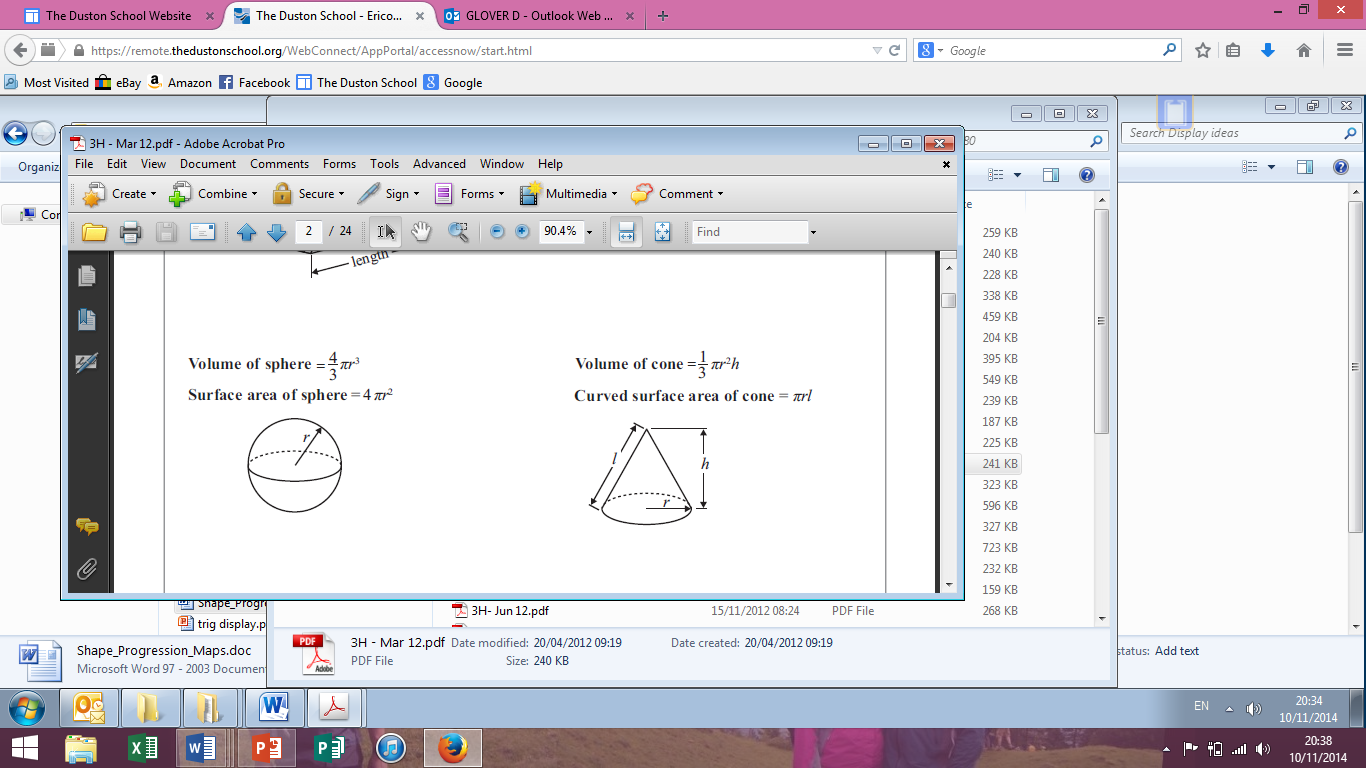
Volume of sphere = \(\frac{4}{3}\pi r^3\)
Surface area of sphere = \(4\pi r^2\)
Volume of cone = \(\frac{1}{3}\pi r^2 h\)
Curved surface area of cone = \(\pi r l\)
1.6 marks
The diagram shows a storage tank.
Diagram NOT accurately drawn.
The storage tank consists of a hemisphere on top of a cylinder.
The height of the cylinder is 30 metres.
The radius of the cylinder is 3 metres.
The radius of the hemisphere is 3 metres.
(a)
Calculate the total volume of the storage tank. Give your answer correct to 3 significant figures.
A sphere has a volume of 500 m³.
(b)
Calculate the radius of the sphere. Give your answer correct to 3 significant figures.
Worked solution
(a)
Volume of the cylinder: \(V_{\text{cyl}} = \pi r^2 h = \pi \times 3^2 \times 30 = 270\pi\).
Volume of the hemisphere: \(V_{\text{hemi}} = \frac{1}{2} \times \frac{4}{3}\pi r^3 = \frac{2}{3}\pi \times 3^3 = \frac{2}{3}\pi \times 27 = 18\pi\).
The sphere sinks to the bottom, so it displaces water equal to its own volume.
The base area of the rectangular container is \(12 \times 11 = 132\) cm\(^2\).
Rise in water level: \(\text{rise} = \frac{\text{volume of sphere}}{\text{base area}} = \frac{179.594\ldots}{132} = 1.360\ldots\).
Round to 3 significant figures: rise \(= 1.36\) cm.
Answer: \(1.36\) cm
Similar Length, Area and Volume (LAV)
6 questions
Things to remember
Linear SF = x
Area SF = x²
Volume SF = x³
1.3 marks
Cylinder A and cylinder B are mathematically similar. The length of cylinder A is 4 cm and the length of cylinder B is 6 cm. The volume of cylinder A is 80 cm³.
Calculate the volume of cylinder B.
Worked solution
Find the linear scale factor from cylinder A to cylinder B: \(k = \dfrac{6}{4} = \dfrac{3}{2}\).
The volume scale factor is \(k^3 = \left(\dfrac{3}{2}\right)^3 = \dfrac{27}{8}\).
Volume of B \(= 80 \times \dfrac{27}{8} = 270\) cm³.
Answer: \(270\) cm³
2.5 marks
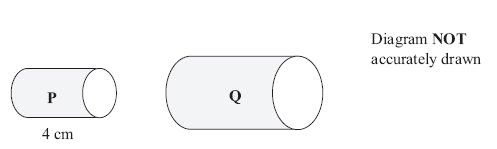
Two cylinders, P and Q, are mathematically similar. The total surface area of cylinder P is \(90\pi\) cm². The total surface area of cylinder Q is \(810\pi\) cm². The length of cylinder P is 4 cm.
(a)
Work out the length of cylinder Q.
The volume of cylinder P is \(100\pi\) cm³.
(b)
Work out the volume of cylinder Q. Give your answer as a multiple of \(\pi\)
Worked solution
(a)
Find the area scale factor: \(\dfrac{810\pi}{90\pi} = 9\).
The linear scale factor is \(k = \sqrt{9} = 3\).
Length of Q \(= 4 \times 3 = 12\) cm.
Answer: \(12\) cm
(b)
The volume scale factor is \(k^3 = 3^3 = 27\).
Volume of Q \(= 100\pi \times 27 = 2700\pi\) cm³.
Answer: \(2700\pi\) cm³
3.4 marks
Diagram NOT accurately drawn Two prisms, A and B, are mathematically similar. The volume of prism A is 12 000 cm³. The volume of prism B is 49 152 cm³. The total surface area of prism B is 9728 cm².
Calculate the total surface area of prism A.
Worked solution
Find the volume scale factor from A to B: \(\dfrac{49\,152}{12\,000} = 4.096\).
Find the linear scale factor: \(k = \sqrt[3]{4.096} = 1.6\).
Find the area scale factor: \(k^2 = 1.6^2 = 2.56\).
Surface area of A \(= \dfrac{9728}{2.56} = 3800\) cm².
Answer: \(3800\) cm²
4.5 marks
Diagram NOT accurately drawn Two cones, P and Q, are mathematically similar. The total surface area of cone P is 24 cm². The total surface area of cone Q is 96 cm². The height of cone P is 4 cm.
(a)
Work out the height of cone Q.
The volume of cone P is 12 cm³.
(b)
Work out the volume of cone Q.
Worked solution
(a)
Find the area scale factor: \(\dfrac{96}{24} = 4\).
Find the linear scale factor: \(k = \sqrt{4} = 2\).
Height of Q \(= 4 \times 2 = 8\) cm.
Answer: \(8\) cm
(b)
The volume scale factor is \(k^3 = 2^3 = 8\).
Volume of Q \(= 12 \times 8 = 96\) cm³.
Answer: \(96\) cm³
5.4 marks
Diagram NOT accurately drawn Two solid shapes, A and B, are mathematically similar. The base of shape A is a circle with radius 4 cm. The base of shape B is a circle with radius 8 cm. The surface area of shape A is 80 cm².
(a)
Work out the surface area of shape B.
The volume of shape B is 600 cm³.
(b)
Work out the volume of shape A.
Worked solution
(a)
Find the linear scale factor from A to B: \(k = \dfrac{8}{4} = 2\).
The area scale factor is \(k^2 = 2^2 = 4\).
Surface area of B \(= 80 \times 4 = 320\) cm².
Answer: \(320\) cm²
(b)
The volume scale factor from A to B is \(k^3 = 2^3 = 8\).
Volume of A \(= \dfrac{600}{8} = 75\) cm³.
Answer: \(75\) cm³
6.3 marks
Diagram NOT accurately drawn The two cylinders, A and B, are mathematically similar. The height of cylinder B is twice the height of cylinder A. The total surface area of cylinder A is 180 cm².
Calculate the total surface area of cylinder B.
Worked solution
The linear scale factor from A to B is \(k = 2\) (height of B is twice the height of A).
The area scale factor is \(k^2 = 2^2 = 4\).
Total surface area of B \(= 180 \times 4 = 720\) cm².
Answer: \(720\) cm²
Averages from Tables
6 questions
Things to remember
Mode = highest frequency
Median position via (n+1)/2
Mean = \(\frac{\Sigma fx}{\Sigma f}\), i.e. the total frequency \(\times\) midpoint divided by the total frequency
Check answer looks realistic
1.4 marks
Zach has 10 CDs. The table gives some information about the number of tracks on each CD.
Number of tracks
Frequency
11
1
12
3
13
0
14
2
15
4
(a)
Write down the mode.
(b)
Work out the mean.
Worked solution
(a)
The mode is the value with the highest frequency.
From the table: 11 has frequency 1, 12 has frequency 3, 13 has frequency 0, 14 has frequency 2, 15 has frequency 4.
The highest frequency is 4, which corresponds to 15 tracks.
Mean \(= \dfrac{\Sigma fx}{\Sigma f} = \dfrac{135}{10} = 13.5\).
Answer: \(13.5\)
2.3 marks
30 adults took part in a survey. They were each asked how much money they spent on lottery tickets last week. The table shows the results of the survey.
Money (\(\pounds\))
Frequency
0
5
2
16
4
6
20
2
30
1
Work out the mean amount of money the 30 adults spent on lottery tickets.
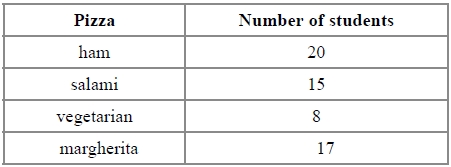
Kate takes a sample of 60 of the students at the school.
She asks each student to tell her one type of pizza they want.
The table shows information about her results.
Pizza
Number of students
ham
20
salami
15
vegetarian
8
margherita
17
Work out how much ham pizza Kate should order.
Write down any assumption you make and explain how this could affect your answer.
Worked solution
In the sample, \(20\) out of \(60\) students chose ham pizza.
Scale up to the full school: \(\dfrac{20}{60} \times 1200 = 400\).
Kate should order \(400\) ham pizzas.
Assumption: the sample is representative of all 1200 students. If the sample is not representative (e.g. biased towards certain year groups or tastes), the actual number of students wanting ham pizza could be higher or lower, so she could order too much or too little.
Answer: \(400\) ham pizzas. Assumption: the sample is representative of the whole school; if not, the estimate could be too high or too low.
7.2 marks(a)
Max wants to take a random sample of students from his year group.
(i)
Explain what is meant by a random sample.
(ii)
Describe a method Max could use to take his random sample.
Worked solution
(i)
A random sample is one where every member of the population has an equal chance of being selected.
Answer: Every member of the population has an equal chance of being selected.
(ii)
Assign each student in the year group a unique number.
Use a random number generator to select the required number of students.
Answer: Number all students and use a random number generator to pick the sample.
8.2 marks
The table below shows the numbers of students in 5 year groups at a school.
Year
Number of students
9
236
10
257
11
252
12
190
13
206
Lisa takes a stratified sample of 100 students by year group.
Work out the number of students from Year 9 she has in her sample.
Worked solution
Total number of students: \(236 + 257 + 252 + 190 + 206 = 1141\).
Stratified sample from Year 9: \(\dfrac{236}{1141} \times 100 = 20.68\ldots\)
Round to the nearest integer: \(\approx 21\).
Answer: \(21\) students
Probability Trees
11 questions
Things to remember
Branches sum to 1
With/without replacement
AND=×, OR=+
1.2 marks
Amy has 10 CDs in a CD holder.
Amy's favourite group is Edex.
She has 6 Edex CDs in the CD holder.
Amy takes one of these CDs at random.
She writes down whether or not it is an Edex CD.
She puts the CD back in the holder.
Amy again takes one of these CDs at random.
(a)
Complete the probability tree diagram.
Worked solution
There are 10 CDs in total, 6 are Edex and 4 are not Edex.
P(Edex) = \(\dfrac{6}{10} = \dfrac{3}{5}\).
P(Not Edex) = \(\dfrac{4}{10} = \dfrac{2}{5}\).
The CD is replaced, so the second choice has the same probabilities.
First choice branches: Edex CD \(\dfrac{3}{5}\), Not Edex CD \(\dfrac{2}{5}\).
Second choice branches (from each): Edex CD \(\dfrac{3}{5}\), Not Edex CD \(\dfrac{2}{5}\).
Answer: First choice: P(Edex) = \(\dfrac{3}{5}\), P(Not Edex) = \(\dfrac{2}{5}\). Second choice (from each branch): P(Edex) = \(\dfrac{3}{5}\), P(Not Edex) = \(\dfrac{2}{5}\).
2.3 marks
Amy had 30 CDs.
The mean playing time of these 30 CDs was 42 minutes.
Amy sold 5 of her CDs.
The mean playing time of the 25 CDs left was 42.8 minutes.
(b)
Calculate the mean playing time of the 5 CDs that Amy sold.
Worked solution
Total playing time for 30 CDs: \(30 \times 42 = 1260\) minutes.
Total playing time for 25 remaining CDs: \(25 \times 42.8 = 1070\) minutes.
Total playing time for 5 sold CDs: \(1260 - 1070 = 190\) minutes.
Mean playing time of sold CDs: \(190 \div 5 = 38\) minutes.
Answer: \(38\) minutes
3.2 marks
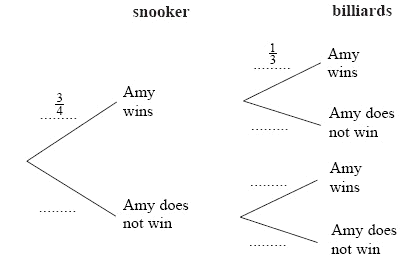
Amy is going to play one game of snooker and one game of billiards.
The probability that she will win the game of snooker is \(\frac{3}{4}\).
The probability that she will win the game of billiards is \(\frac{1}{3}\).
Complete the probability tree diagram.
Worked solution
P(Amy wins snooker) = \(\dfrac{3}{4}\), so P(Amy does not win snooker) = \(1 - \dfrac{3}{4} = \dfrac{1}{4}\).
P(Amy wins billiards) = \(\dfrac{1}{3}\), so P(Amy does not win billiards) = \(1 - \dfrac{1}{3} = \dfrac{2}{3}\).
Snooker branches: Amy wins \(\dfrac{3}{4}\), Amy does not win \(\dfrac{1}{4}\).
Billiards branches (from each snooker outcome): Amy wins \(\dfrac{1}{3}\), Amy does not win \(\dfrac{2}{3}\).
The drawing pin is dropped twice independently, so both drops have the same probabilities.
First drop branches: Point up (0.4), Point down (0.6).
Second drop branches (from each): Point up (0.4), Point down (0.6).
Answer: First drop: P(Point up) = 0.4, P(Point down) = 0.6. Second drop (from each branch): P(Point up) = 0.4, P(Point down) = 0.6.
6.2 marks(b)
Work out the probability that the drawing pin will land 'point up' both times.
Worked solution
Both times 'point up' means: Point up AND Point up.
Multiply along the branches (AND rule): \(0.4 \times 0.4 = 0.16\).
Answer: \(0.16\)
7.2 marks
Matthew puts 3 red counters and 5 blue counters in a bag. He takes at random a counter from the bag. He writes down the colour of the counter. He puts the counter in the bag again. He then takes at random a second counter from the bag.
Work out the probability that Matthew takes two red counters.
Worked solution
Two red counters means: Red AND Red.
Multiply along the branches (AND rule): \(\dfrac{3}{8} \times \dfrac{3}{8} = \dfrac{9}{64}\).
Answer: \(\dfrac{9}{64}\)
9.2 marks
Julie has 100 music CDs. 58 of the CDs are classical. 22 of the CDs are folk. The rest of the CDs are jazz. On Saturday, Julie chooses one CD at random from the 100 CDs. On Sunday, Julie chooses one CD at random from the 100 CDs.
(a)
Complete the probability tree diagram.
Worked solution
100 CDs: 58 classical, 22 folk, rest jazz. Number of jazz CDs: \(100 - 58 - 22 = 20\).
On a farm, \(4\frac{1}{2}\) out of every 15 acres of the land are used to grow crops.
Wheat is grown on \(\frac{2}{3}\) of the land used to grow crops.
What percentage of the total area of the land on the farm is used to grow wheat?
Worked solution
Land used to grow crops: \(4\frac{1}{2} = \frac{9}{2}\) acres out of every 15 acres.
Wheat is \(\frac{2}{3}\) of the crop land: \(\frac{2}{3} \times \frac{9}{2} = \frac{18}{6} = 3\) acres.
Percentage of total land: \(\frac{3}{15} \times 100 = 20\%\).
Answer: \(20\%\)
Percentages – compound interest
7 questions
Things to remember
Number of years
1.2 marksHenry invests \(\pounds 4500\) at a compound interest rate of \(5\%\) per annum.
At the end of \(n\) complete years the investment has grown to \(\pounds 5469.78\).
Find the value of \(n\).
Worked solution
The compound interest multiplier is \(1 + \frac{5}{100} = 1.05\).
Use \(P_n = P_0 \times 1.05^n\) and work year by year:
Year 1: \(4500 \times 1.05 = \pounds 4725.00\)
Year 2: \(4725.00 \times 1.05 = \pounds 4961.25\)
Year 3: \(4961.25 \times 1.05 = \pounds 5209.31\)
Year 4: \(5209.31 \times 1.05 = \pounds 5469.78\) ✓
So \(n = 4\).
Answer: n = 4
2.3 marks
Worked solution
(a)
Each year the machine is multiplied by \(1 - \frac{20}{100} = 0.8\).
Multiplying by 0.8 makes the value smaller each year, but it never reaches zero.
Bill is wrong because 20% depreciation each year means 20% of the remaining value is lost, not 20% of the original value. The value gets smaller but will never be zero.
Answer: Each year the value is multiplied by 0.8, so the value decreases but never reaches zero.
(b)
The depreciation multiplier is \(1 - \frac{20}{100} = 0.8\).
After 2 years the single multiplier is \(0.8^2 = 0.64\).
Bill should multiply the original value by 0.64.
Answer: 0.64
3.3 marksGwen bought a new car. Each year, the value of her car depreciated by \(9\%\).
Calculate the number of years after which the value of her car was \(47\%\) of its value when new.
Worked solution
The depreciation multiplier is \(1 - \frac{9}{100} = 0.91\).
After \(n\) years the value is \(0.91^n\) of the original. Find \(n\) such that \(0.91^n \approx 0.47\).
Year 1: \(0.91^1 = 0.91\) (91%)
Year 2: \(0.91^2 = 0.8281\) (82.81%)
Year 3: \(0.91^3 = 0.753571\) (75.36%)
Year 4: \(0.91^4 = 0.685749...\) (68.57%)
Year 5: \(0.91^5 = 0.624032...\) (62.40%)
Year 6: \(0.91^6 = 0.567869...\) (56.79%)
Year 7: \(0.91^7 = 0.516761...\) (51.68%)
Year 8: \(0.91^8 = 0.470253...\) (47.03% \approx 47%)
After 8 years the value is approximately 47% of the original.
Answer: 8 years
4.3 marksThe value of a car depreciates by \(35\%\) each year.
At the end of 2007 the value of the car was \(\pounds 5480\).
Work out the value of the car at the end of 2006.
Worked solution
The depreciation multiplier is \(1 - \frac{35}{100} = 0.65\).
The value at end of 2007 = value at end of 2006 \(\times 0.65\).
The compound interest multiplier is \(1 + \frac{7.5}{100} = 1.075\).
Use \(P_n = 2400 \times 1.075^n\) and work year by year:
Year 1: \(2400 \times 1.075 = \pounds 2580.00\)
Year 2: \(2580.00 \times 1.075 = \pounds 2773.50\)
Year 3: \(2773.50 \times 1.075 = \pounds 2981.51\)
Year 4: \(2981.51 \times 1.075 = \pounds 3205.13\)
Year 5: \(3205.13 \times 1.075 = \pounds 3445.51\) ✓
So \(n = 5\).
Answer: n = 5
6.3 marksMario invests \(\pounds 2000\) for 3 years at \(5\%\) per annum **compound** interest.
Calculate the value of the investment at the end of 3 years.
Worked solution
The compound interest multiplier is \(1 + \frac{5}{100} = 1.05\).
7.3 marksToby invested \(\pounds 4500\) for 2 years in a savings account.
He was paid \(4\%\) per annum compound interest.
How much did Toby have in his savings account after 2 years?
Worked solution
The compound interest multiplier is \(1 + \frac{4}{100} = 1.04\).
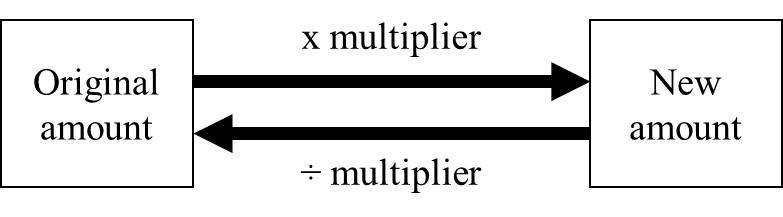
Work out the multiplier; Original × multiplier = New, ÷ multiplier
1.3 marks
Loft insulation reduces annual heating costs by 20%.
After he insulated his loft, Curtley's annual heating cost was £520.
Work out Curtley's annual heating cost would have been, if he had not insulated his loft.
Worked solution
A 20% reduction means the multiplier is \(1 - \frac{20}{100} = 0.8\).
Original \(\times\) multiplier = New, so Original = New \(\div\) multiplier.
Original = \(\frac{520}{0.8} = \pounds 650.00\).
Answer: \(\pounds 650.00\)
2.3 marks
In a sale, normal prices are reduced by 20%.
SALE 20% OFF
Andrew bought a saddle for his horse in the sale.
The sale price of the saddle was £220.
Calculate the normal price of the saddle.
Worked solution
A 20% reduction means the multiplier is \(1 - \frac{20}{100} = 0.8\).
Original = New \(\div\) multiplier.
Original = \(\frac{220}{0.8} = \pounds 275.00\).
Answer: \(\pounds 275.00\)
3.3 marks
Hajra's weekly pay this year is £240
This is 20% more than her weekly pay last year.
Bill says 'This means Hajra's weekly pay last year was £192'.
Bill is wrong.
(a)
Explain why.
(b)
Work out Hajra's weekly pay last year.
Worked solution
(a)
Bill found 20% of \(\pounds 240\): \(0.2 \times 240 = \pounds 48\), then subtracted: \(240 - 48 = \pounds 192\).
This is wrong because \(\pounds 240\) is the amount after the 20% increase, not the original. He should divide by the multiplier, not subtract 20% of the new amount.
Answer: Bill subtracted 20% of the new amount (\(\pounds 240\)) instead of dividing by the multiplier 1.2. The 20% increase was on the original pay, not on \(\pounds 240\).
(b)
A 20% increase means the multiplier is \(1 + \frac{20}{100} = 1.2\).
Original = New \(\div\) multiplier.
Original = \(\frac{240}{1.2} = \pounds 200.00\).
Answer: \(\pounds 200.00\)
4.5 marks
The price of all rail season tickets to London increased by 4%.
(a)
The price of a rail season ticket from Cambridge to London increased by £121.60
Work out the price before this increase.
(b)
After the increase, the price of a rail season ticket from Brighton to London was £2638.80
Work out the price before this increase.
Worked solution
(a)
A 4% increase means the increase is 4% of the original price.
4% of original = \(\pounds 121.60\).
Original = \(\frac{121.60}{0.04} = \pounds 3040.00\).
Answer: \(\pounds 3040.00\)
(b)
A 4% increase means the multiplier is \(1 + \frac{4}{100} = 1.04\).
Original = New \(\div\) multiplier.
Original = \(\frac{2638.80}{1.04} = \pounds 2537.50\).
Answer: \(\pounds 2537.50\)
5.3 marks
In a sale, normal prices are reduced by 25%.
The sale price of a saw is £12.75
Calculate the normal price of the saw.
Worked solution
A 25% reduction means the multiplier is \(1 - \frac{25}{100} = 0.75\).
Original = New \(\div\) multiplier.
Original = \(\frac{12.75}{0.75} = \pounds 17.00\).
Answer: \(\pounds 17.00\)
6.3 marks
In a sale, normal prices are reduced by 12%.
The sale price of a DVD player is £242.
Work out the normal price of the DVD player.
Worked solution
A 12% reduction means the multiplier is \(1 - \frac{12}{100} = 0.88\).
Original = New \(\div\) multiplier.
Original = \(\frac{242}{0.88} = \pounds 275.00\).
Answer: \(\pounds 275.00\)
7.3 marks
A garage sells cars.
It offers a discount of 20% off the normal price for cash.
Dave pays £5200 cash for a car.
Calculate the normal price of the car.
Worked solution
A 20% discount means the multiplier is \(1 - \frac{20}{100} = 0.8\).
Original = New \(\div\) multiplier.
Original = \(\frac{5200}{0.8} = \pounds 6500.00\).