Order the numbers 0.354, 0.4, 0.35, 0.345 from smallest to largest.
Write each to three decimal places: \(0.354\), \(0.400\), \(0.350\), \(0.345\).
Compare: \(0.345 < 0.350 < 0.354 < 0.400\).
Answer: 0.345, 0.35, 0.354, 0.4
6.4 marks
Here are four cards. There is a number on each card.
[Diagram: four cards showing the numbers 4, 5, 2, and 1]
(a)
Write down the largest 4-digit even number that can be made using each card only once.
(b)
Write down all the 2-digit numbers that can be made using these cards.
Worked solution
(a)
Find the largest 4-digit even number using the cards 4, 5, 2, 1 (each used once).
For the number to be even, the last digit must be even. The even digits available are 2 and 4.
To make the largest number, put the largest digits first. If the last digit is 2, the remaining digits in descending order give \(5412\). If the last digit is 4, the remaining digits give \(5214\).
Compare: \(5412 > 5214\).
Answer: 5412
(b)
List all 2-digit numbers using the cards 4, 5, 2, 1 (each card used at most once per number).
Write these numbers in order of size. Start with the smallest number.
3007 4435 399 4011 3333
(b)
Write these numbers in order of size. Start with the smallest number.
3.7 5.62 0.7 14.3
(c)
Write \(\frac{9}{10}\) as a decimal.
Worked solution
(a)
Order the numbers 3007, 4435, 399, 4011, 3333 from smallest to largest.
\(399\) is the smallest (only 3 digits). Then compare thousands: \(3007 < 3333\), and \(4011 < 4435\).
Order: \(399, 3007, 3333, 4011, 4435\).
Answer: 399, 3007, 3333, 4011, 4435
(b)
Order the numbers 3.7, 5.62, 0.7, 14.3 from smallest to largest.
Compare: \(0.7 < 3.7 < 5.62 < 14.3\).
Answer: 0.7, 3.7, 5.62, 14.3
(c)
Write \(\frac{9}{10}\) as a decimal.
\(\frac{9}{10}\) means 9 tenths, which is \(0.9\).
Answer: 0.9
8.1 mark
Write the following numbers in order of size. Start with the smallest number.
0.61 0.1 0.16 0.106
Worked solution
Order the numbers 0.61, 0.1, 0.16, 0.106 from smallest to largest.
Write each to three decimal places: \(0.610\), \(0.100\), \(0.160\), \(0.106\).
Compare: \(0.100 < 0.106 < 0.160 < 0.610\).
Answer: 0.1, 0.106, 0.16, 0.61
Directed Numbers
8 questions
Things to remember
Mixed means minus!
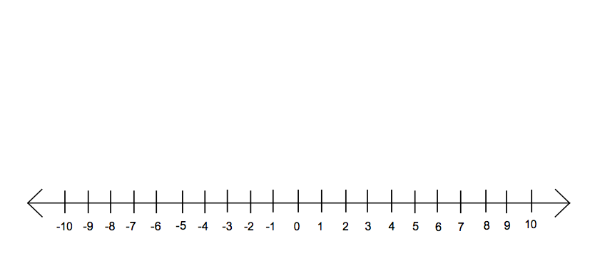
Use a number line – if you’re adding you need to move in a positive direction (right), if you’re subtracting you need to move in a negative direction (left).
[Diagram: a horizontal number line marked from −10 to 10, with integer tick marks at every unit. The line has arrows at both ends indicating it extends in both directions.]
1.5 marks
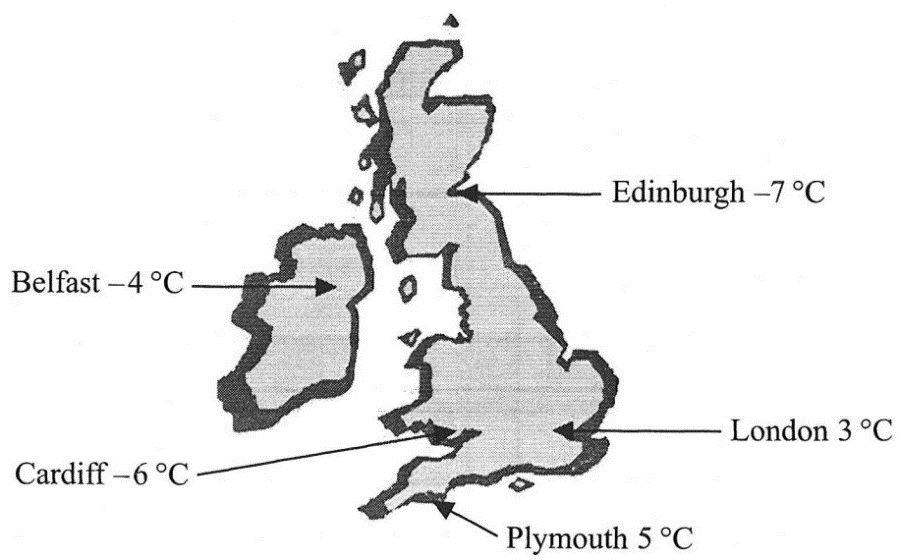
Here is a map of the British Isles.
The temperatures in some places, one night last winter are shown on the map.
[Diagram: a map of the British Isles showing temperatures at five cities: Edinburgh \(-7\,^\circ\text{C}\), Belfast \(-4\,^\circ\text{C}\), London \(3\,^\circ\text{C}\), Cardiff \(-6\,^\circ\text{C}\), and Plymouth \(5\,^\circ\text{C}\).]
(a)(i)
Write down the names of the two places that had the biggest difference in temperature.
(ii)
Work out the difference in temperature between these two places.
(b)
Two pairs of places have a difference in temperature of \(2\,^\circ\text{C}\). Write down the names of these places.
(i)
..................... and .....................
(ii)
..................... and .....................
Worked solution
(a)(i)
List the temperatures: Edinburgh \(-7\,^\circ\text{C}\), Belfast \(-4\,^\circ\text{C}\), London \(3\,^\circ\text{C}\), Cardiff \(-6\,^\circ\text{C}\), Plymouth \(5\,^\circ\text{C}\).
The lowest temperature is Edinburgh at \(-7\,^\circ\text{C}\) and the highest temperature is Plymouth at \(5\,^\circ\text{C}\).
These two places have the biggest difference in temperature.
Answer: Edinburgh and Plymouth
(a)(ii)
Difference \(= 5 - (-7) = 5 + 7 = 12\).
Answer: \(12\,^\circ\text{C}\)
(b)(i)
Check pairs for a difference of \(2\,^\circ\text{C}\).
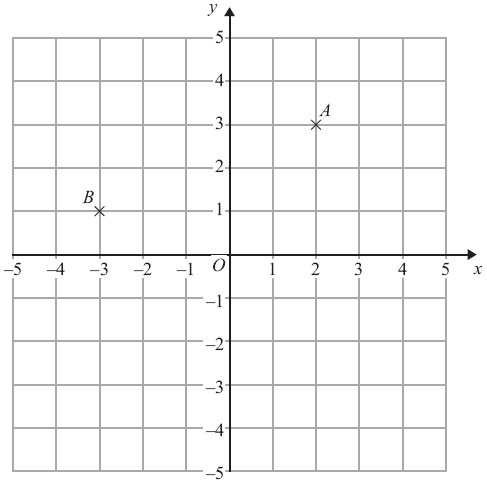
On the grid, mark the point \((6, 4)\) with the letter P.
(ii)
On the grid, mark the point \((3, 0)\) with the letter Q.
Worked solution
(a)(i)
Read the coordinates of A from the grid: \(x = 2\), \(y = 5\).
Answer: \((2, 5)\)
(a)(ii)
Read the coordinates of B from the grid: \(x = 5\), \(y = 2\).
Answer: \((5, 2)\)
(b)(i)
Plot the point at \(x = 6\), \(y = 4\) on the grid and label it P.
(b)(ii)
Plot the point at \(x = 3\), \(y = 0\) on the grid and label it Q.
4.4 marks
(a)
Write down the coordinates of the point
(i)
A.
(ii)
C.
(b)(i)
On the grid, mark the point D so that ABCD is a rectangle.
(ii)
Write down the coordinates of D.
Worked solution
(a)(i)
Read the coordinates of A from the grid: \(x = 1\), \(y = 6\).
Answer: \((1, 6)\)
(a)(ii)
Read the coordinates of C from the grid: \(x = 6\), \(y = 3\).
Answer: \((6, 3)\)
(b)(i)
In rectangle ABCD, A is at \((1, 6)\), B is at \((6, 6)\), and C is at \((6, 3)\).
D must share the same x-coordinate as A and the same y-coordinate as C.
Plot D at \((1, 3)\) on the grid.
(b)(ii)
From the rectangle, D is at \((1, 3)\).
Answer: \((1, 3)\)
5.3 marks
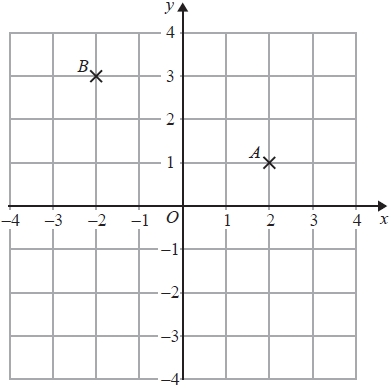
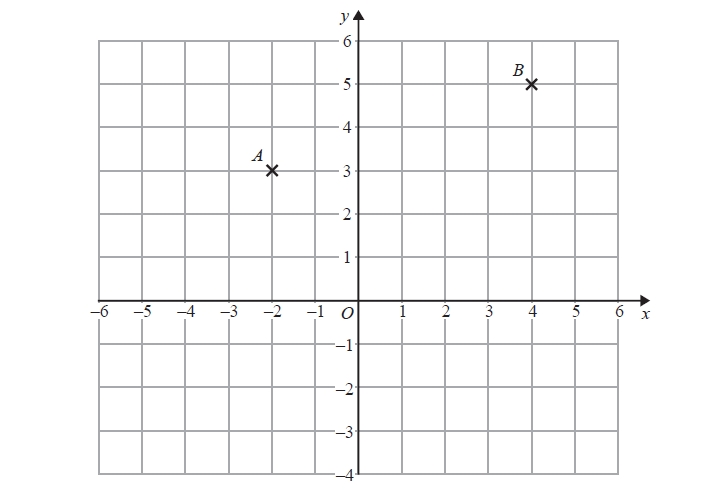
(a)
Write down the coordinates of the point A.
(b)
Write down the coordinates of the point B.
(c)
On the grid, mark with a cross (\(\times\)) the point \((-3, -1)\). Label this point C.
Worked solution
(a)
Read the coordinates of A from the grid: \(x = -2\), \(y = 3\).
Answer: \((-2, 3)\)
(b)
Read the coordinates of B from the grid: \(x = 4\), \(y = -1\).
Answer: \((4, -1)\)
(c)
Plot the point at \(x = -3\), \(y = -1\) on the grid and label it C.
6.3 marks
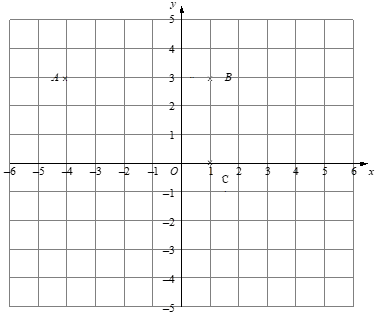
[Diagram: a coordinate grid with x-axis from \(-5\) to \(5\) and y-axis from \(-5\) to \(5\). Point A is plotted at approximately \((-3, 4)\) and point B is plotted at approximately \((-2, -2)\).]
(a)(i)
Write down the coordinates of the point A.
(ii)
Write down the coordinates of the point B.
(b)
On the grid, mark with a cross the point \((3, -4)\). Label this point C.
Worked solution
(a)(i)
Read the coordinates of A from the grid: \(x = -3\), \(y = 4\).
Answer: \((-3, 4)\)
(a)(ii)
Read the coordinates of B from the grid: \(x = -2\), \(y = -2\).
Answer: \((-2, -2)\)
(b)
Plot the point at \(x = 3\), \(y = -4\) on the grid and label it C.
7.3 marks
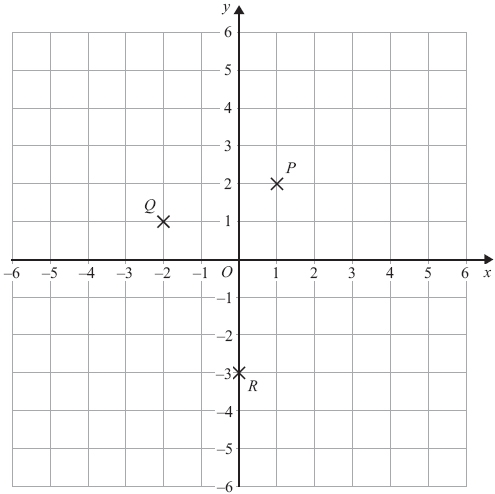
(a)
Write down the coordinates of the point P.
(b)
Write down the coordinates of the point R.
P, Q and R are three vertices of a parallelogram.
(c)
Write down the coordinates of the fourth vertex of this parallelogram.
Worked solution
(a)
Read the coordinates of P from the grid: \(x = 3\), \(y = 2\).
Answer: \((3, 2)\)
(b)
Read the coordinates of R from the grid: \(x = -1\), \(y = 2\).
Answer: \((-1, 2)\)
(c)
In a parallelogram, opposite sides are equal and parallel.
The vector from R to P is \((3 - (-1),\, 2 - 2) = (4, 0)\).
Apply this same vector to Q: \((-3 + 4,\, -1 + 0) = (1, -1)\).
The fourth vertex is \((1, -1)\).
Answer: \((1, -1)\)
8.2 marks
[Diagram: a coordinate grid with x-axis from \(-5\) to \(5\) and y-axis from \(-5\) to \(5\). Point A is plotted at approximately \((-4, -3)\) marked with \(\times\), and point B is plotted at approximately \((4, 1)\) marked with \(\times\).]
(a)
Write down the coordinates of point B.
(b)
Find the coordinates of the midpoint of AB.
Worked solution
(a)
Read the coordinates of B from the grid: \(x = 4\), \(y = 1\).
Answer: \((4, 1)\)
(b)
The midpoint is found by averaging the coordinates of A and B.
Set up the equation using the rule: \(4h + 12 = 40\), where \(h\) is the number of hours.
Subtract 12 from both sides: \(4h = 40 - 12 = 28\).
Divide both sides by 4: \(h = 28 \div 4 = 7\).
Answer: \(7\) hours
3.3 marks(a)
Solve \(6g = 18\)
(b)
Solve \(5h + 7 = 17\)
Worked solution
(a)
\(6g = 18\).
Divide both sides by 6: \(g = 18 \div 6 = 3\).
Answer: \(g = 3\)
(b)
\(5h + 7 = 17\).
Subtract 7 from both sides: \(5h = 17 - 7 = 10\).
Divide both sides by 5: \(h = 10 \div 5 = 2\).
Answer: \(h = 2\)
4.3 marks(a)
Solve \(x + 9 = 19\)
(b)
Solve \(2y = 17\)
(c)
Solve \(\dfrac{w}{2} = 8\)
Worked solution
(a)
\(x + 9 = 19\).
Subtract 9 from both sides: \(x = 19 - 9 = 10\).
Answer: \(x = 10\)
(b)
\(2y = 17\).
Divide both sides by 2: \(y = 17 \div 2 = 8.5\).
Answer: \(y = 8.5\)
(c)
\(\dfrac{w}{2} = 8\).
Multiply both sides by 2: \(w = 8 \times 2 = 16\).
Answer: \(w = 16\)
5.3 marks(a)
Solve \(\dfrac{n}{7} = 2\)
(b)
Solve \(3g + 4 = 19\)
Worked solution
(a)
\(\dfrac{n}{7} = 2\).
Multiply both sides by 7: \(n = 2 \times 7 = 14\).
Answer: \(n = 14\)
(b)
\(3g + 4 = 19\).
Subtract 4 from both sides: \(3g = 19 - 4 = 15\).
Divide both sides by 3: \(g = 15 \div 3 = 5\).
Answer: \(g = 5\)
6.2 marks(a)
Solve \(4x = 20\)
(b)
Solve \(y - 9 = 17\)
Worked solution
(a)
\(4x = 20\).
Divide both sides by 4: \(x = 20 \div 4 = 5\).
Answer: \(x = 5\)
(b)
\(y - 9 = 17\).
Add 9 to both sides: \(y = 17 + 9 = 26\).
Answer: \(y = 26\)
7.2 marks
Solve \(3x + 7 = 1\)
Worked solution
\(3x + 7 = 1\).
Subtract 7 from both sides: \(3x = 1 - 7 = -6\).
Divide both sides by 3: \(x = -6 \div 3 = -2\).
Answer: \(x = -2\)
8.2 marks
Solve \(4x + 5 = x + 26\)
Worked solution
\(4x + 5 = x + 26\).
Subtract \(x\) from both sides: \(3x + 5 = 26\).
Subtract 5 from both sides: \(3x = 21\).
Divide both sides by 3: \(x = 7\).
Answer: \(x = 7\)
Inequalities
8 questions
Things to remember
< means less than
> means greater than
≤ means less than or equal to
≥ means greater than or equal to
An integer is a whole number
On a number line, use a full circle to show a value can be equal, and an empty circle to show it cannot.
1.2 marks
\(-4 < n \le 3\)
\(n\) is an integer.
Write down all the possible values of \(n\).
Worked solution
The inequality \(-4 < n \le 3\) means \(n\) is greater than \(-4\) but less than or equal to \(3\).
Since \(n\) must be an integer and \(n\) is strictly greater than \(-4\), the smallest value is \(-3\). Since \(n \le 3\), the largest value is \(3\).
The possible values of \(n\) are: \(-3,\; -2,\; -1,\; 0,\; 1,\; 2,\; 3\)
2.4 marks(a)
\(n\) is an integer.
\(-1 \le n < 4\)
List the possible values of \(n\).
(b)
Write down the inequality shown in the diagram.
Worked solution
(a)
The inequality \(-1 \le n < 4\) means \(n\) is greater than or equal to \(-1\) and strictly less than \(4\).
Since \(n\) is an integer, the smallest value is \(-1\) and the largest value is \(3\).
The possible values of \(n\) are: \(-1,\; 0,\; 1,\; 2,\; 3\)
(b)
The empty circle at \(-4\) means \(x\) cannot equal \(-4\), so we use a strict inequality: \(x > -4\).
The full circle at \(3\) means \(x\) can equal \(3\), so we use: \(x \le 3\).
The inequality shown is \(-4 < x \le 3\)
3.2 marks
Here is an inequality, in \(x\), shown on a number line.
Write down the inequality.
Worked solution
The empty circle at \(-2\) means \(x\) cannot equal \(-2\).
The solid line extends to the right with an arrow, meaning \(x\) takes all values greater than \(-2\).
The inequality is \(x > -2\)
4.5 marks
(a)
Write down the inequality represented on the number line.
(b)
\(-3 \le n < 2\)
\(-2 < m < 4\)
\(n\) and \(m\) are integers.
Given that \(n \ne m\), write down all the possible values of \(n\).
Worked solution
(a)
The empty circle at \(-3\) means \(x\) cannot equal \(-3\), and the empty circle at \(4\) means \(x\) cannot equal \(4\).
The inequality represented is \(-3 < x < 4\)
(b)
From \(-3 \le n < 2\), the integer values of \(n\) are: \(-3,\; -2,\; -1,\; 0,\; 1\)
From \(-2 < m < 4\), the integer values of \(m\) are: \(-1,\; 0,\; 1,\; 2,\; 3\)
Since \(n \ne m\), we check each value of \(n\) to see if there exists at least one valid \(m\) that is different from \(n\):
\(n = -3\): \(m\) can be \(-1, 0, 1, 2, 3\) (all different from \(-3\)) ✔
\(n = -2\): \(m\) can be \(-1, 0, 1, 2, 3\) (all different from \(-2\)) ✔
\(n = -1\): \(m\) can be \(0, 1, 2, 3\) ✔
\(n = 0\): \(m\) can be \(-1, 1, 2, 3\) ✔
\(n = 1\): \(m\) can be \(-1, 0, 2, 3\) ✔
All values of \(n\) are possible: \(-3,\; -2,\; -1,\; 0,\; 1\)
5.2 marks
\(-5 < y \le 0\)
\(y\) is an integer.
Write down all the possible values of \(y\).
Worked solution
The inequality \(-5 < y \le 0\) means \(y\) is strictly greater than \(-5\) and less than or equal to \(0\).
Since \(y\) is an integer, the smallest value is \(-4\) and the largest value is \(0\).
The possible values of \(y\) are: \(-4,\; -3,\; -2,\; -1,\; 0\)
6.4 marks(a)
\(n\) is an integer.
\(-1 \le n < 4\)
List the possible values of \(n\).
(b)
Write down the inequality shown in the diagram.
Worked solution
(a)
The inequality \(-1 \le n < 4\) means \(n\) is greater than or equal to \(-1\) and strictly less than \(4\).
Since \(n\) is an integer, the smallest value is \(-1\) and the largest value is \(3\).
The possible values of \(n\) are: \(-1,\; 0,\; 1,\; 2,\; 3\)
(b)
The full circle at \(-4\) means \(x\) can equal \(-4\), so we use \(x \ge -4\).
The empty circle at \(3\) means \(x\) cannot equal \(3\), so we use \(x < 3\).
The inequality shown is \(-4 \le x < 3\)
7.4 marks
\(-4 < n \le 1\)
\(n\) is an integer.
(a)
Write down all the possible values of \(n\).
(b)
Write down the inequalities represented on the number line.
Worked solution
(a)
The inequality \(-4 < n \le 1\) means \(n\) is strictly greater than \(-4\) and less than or equal to \(1\).
Since \(n\) is an integer, the smallest value is \(-3\) and the largest value is \(1\).
The possible values of \(n\) are: \(-3,\; -2,\; -1,\; 0,\; 1\)
(b)
The full circle at \(-2\) means \(x\) can equal \(-2\), and the full circle at \(1\) means \(x\) can equal \(1\).
The inequality represented is \(-2 \le x \le 1\)
8.2 marks
\(-2 < n \le 3\)
Represent this inequality on the number line.
Worked solution
For the inequality \(-2 < n \le 3\):
Since \(n\) is strictly greater than \(-2\) (not equal to), draw an empty circle at \(-2\).
Since \(n\) is less than or equal to \(3\), draw a full circle at \(3\).
Draw a solid line connecting the empty circle at \(-2\) to the full circle at \(3\).
Types of Shapes and their Properties
8 questions
Things to remember
Sides and vertices belong on 2D shapes.
Edges, faces and vertices belong on 3D shapes.
1.3 marks
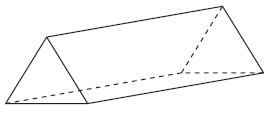
Here is a triangular prism.
(a)
For this prism, write down
(i) the number of edges
(ii) the number of faces
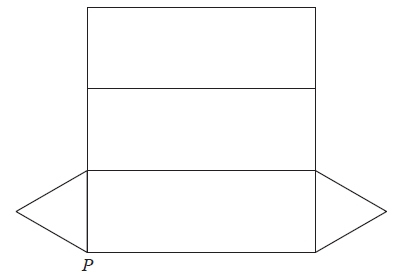
Here is a net of the triangular prism.
The net is folded to make the prism. One other point meets at P.
(b)
Mark this point on the net with the letter P.
Worked solution
(a)(i)
A triangular prism has 9 edges: 3 edges on the front triangular face, 3 edges on the back triangular face, and 3 edges connecting them.
Answer: 9
(a)(ii)
A triangular prism has 5 faces: 2 triangular faces (front and back) and 3 rectangular faces.
Answer: 5
(b)
When the net is folded, the bottom-left corner of the left rectangle (labelled P) meets the bottom-right corner of the right rectangle. That is where the second P should be marked.
Answer: The point P should be marked at the bottom-right corner of the right rectangle in the net.
2.3 marks
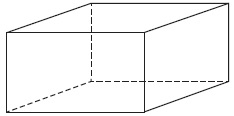
Here is a cuboid.
The following sentences are about cuboids.
Complete each sentence by writing the correct number in the gap.
(i)
A cuboid has ........................... faces.
(ii)
A cuboid has ........................... edges.
(iii)
A cuboid has ........................... vertices.
Worked solution
(i)
A cuboid has 6 faces: top, bottom, front, back, left and right.
Answer: 6
(ii)
A cuboid has 12 edges: 4 on the top face, 4 on the bottom face, and 4 vertical edges connecting them.
Answer: 12
(iii)
A cuboid has 8 vertices: 4 on the top face and 4 on the bottom face.
Answer: 8
3.2 marks(a)
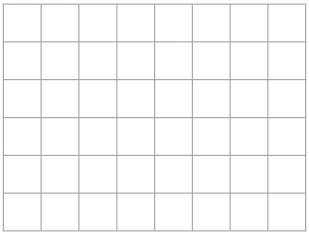
On the grid, draw a kite.
(b)
Here is a quadrilateral.
Write down the special name of this quadrilateral.
Worked solution
(a)
A kite is a quadrilateral with two pairs of consecutive sides that are equal. It has one axis of symmetry. Any correctly drawn kite on the grid is acceptable.
Answer: A kite drawn on the grid: a quadrilateral with two pairs of adjacent sides equal in length and one line of symmetry.
(b)
The shape shown has one pair of parallel sides (the top and bottom), with the top shorter than the bottom, making it a trapezium.
Answer: Trapezium
4.1 mark
Draw a sketch of a pentagon.
Worked solution
A pentagon is any polygon with exactly 5 straight sides and 5 vertices. A regular or irregular pentagon is acceptable.
Answer: A sketch of a five-sided polygon (pentagon).
5.2 marks
Write down the name of each of these 3-D shapes.
(i)
[Diagram: a 3D cylinder shown upright]
(ii)
[Diagram: a 3D triangular prism shown lying on one of its rectangular faces, with dashed lines indicating hidden edges]
Worked solution
(i)
The shape shown is a cylinder — a 3D shape with two parallel circular faces and a curved surface.
Answer: Cylinder
(ii)
The shape shown is a triangular prism — a 3D shape with two triangular faces and three rectangular faces.
Answer: Triangular prism
6.4 marks
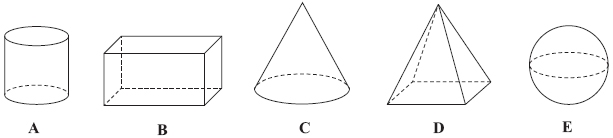
Here are some solid 3-D shapes.
(a)
Write down the letter of the shape that is a sphere.
(b)
Write down the mathematical name of shape A.
(c)
How many faces does shape B have?
(d)
How many edges does shape D have?
Worked solution
(a)
Shape B is the sphere.
Answer: B
(b)
Shape A is a rectangular prism, whose mathematical name is a cuboid.
Answer: Cuboid
(c)
Shape B is a sphere. A sphere has 1 curved face (and no flat faces). At GCSE Foundation level, a sphere is considered to have 1 face.
Answer: 1
(d)
Shape D is a triangular-based pyramid (tetrahedron). It has 6 edges: 3 edges on the triangular base and 3 edges going up to the apex.
Answer: 6
7.2 marks
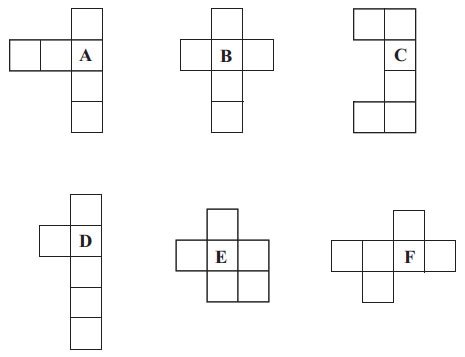
Here are some shapes made from squares.
Two of these shapes are nets of a cube. Which two shapes?
Worked solution
A net of a cube must consist of exactly 6 squares arranged so that they fold into a cube with no overlapping faces. Of the six shapes shown, shapes D (an L-shape) and F (a cross/plus shape) are valid nets of a cube. The other shapes either overlap when folded or do not form a closed cube.
Answer: D and F
8.3 marks
Here is a list of the names of five types of quadrilateral.
Trapezium Parallelogram Square Rhombus Rectangle
(a)
From the list, write down the names of two quadrilaterals which must have all four sides the same length.
(b)
From the list, write down the name of the quadrilateral that has only one pair of parallel sides.
For one of these quadrilaterals: the corners are not right angles, the quadrilateral has rotational symmetry of order 2 and the diagonals cross at right angles.
(c)
Write down the name of this quadrilateral.
Worked solution
(a)
A square has all four sides equal and all angles 90 degrees. A rhombus has all four sides equal but angles are not necessarily 90 degrees. These are the only two quadrilaterals from the list that must have all four sides the same length.
Answer: Square and Rhombus
(b)
A trapezium has exactly one pair of parallel sides. The other quadrilaterals in the list (parallelogram, square, rhombus, rectangle) all have two pairs of parallel sides.
Answer: Trapezium
(c)
The rhombus has no right angles, has rotational symmetry of order 2, and its diagonals cross at right angles. A parallelogram also has order-2 rotational symmetry and non-right-angle corners, but its diagonals do not cross at right angles.
Answer: Rhombus
Reflection, Rotation and Symmetry
8 questions
Things to remember
A reflection is where the shape is flipped.
A rotation is where the shape is turned.
1.2 marks
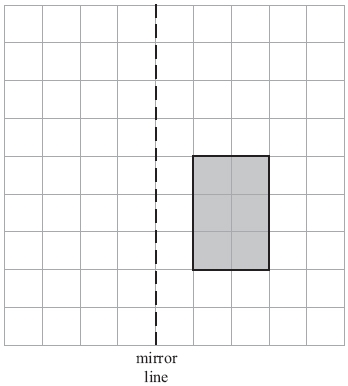
Here is a shaded shape on a grid of centimetre squares.
Reflect the shaded shape in the mirror line.
Worked solution
Identify each square of the L-shaped figure above the horizontal mirror line. The L-shape sits in the upper-right area of the grid, spanning roughly 3 columns and 4 rows.
For a horizontal mirror line, each shaded square is reflected vertically: a square that is d rows above the mirror line maps to d rows below the mirror line, keeping the same column.
Shade the reflected squares below the mirror line to produce a vertically flipped L-shape. The reflected L-shape opens in the opposite vertical direction to the original.
Answer: The reflected L-shape is drawn below the mirror line, forming a mirror image that opens upward (the reverse of the original). Each square is the same horizontal distance from the mirror line as the corresponding original square, but on the opposite side.
2.2 marks(a)
On the grid, shade in one more square so that the completed shape has one line of symmetry.
(b)
On the grid below, shade in two more squares so that the completed shape has rotational symmetry of order 2.
Worked solution
(a)
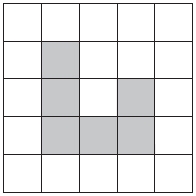
The existing shaded squares are at row 1 column 1, row 1 column 4, and row 2 column 2 (using row-down, column-right numbering).
To obtain one line of symmetry, look for a vertical line of symmetry down the centre of the grid (between columns 2 and 3). Row 1 column 1 reflects to row 1 column 4 (already shaded). Row 2 column 2 would reflect to row 2 column 3.
Shade the square at row 2, column 3. This gives a vertical line of symmetry between columns 2 and 3.
Answer: Shade the square at row 2, column 3. The pattern then has a vertical line of symmetry.
(b)
Rotational symmetry of order 2 means the pattern looks the same after a 180° rotation about the centre of the grid.
The centre of the 4×4 grid is at position (2.5, 2.5). Under 180° rotation, cell (r, c) maps to (5 − r, 5 − c).
Identify which cells are already shaded and determine their 180° partners. Shade the two additional squares so that every shaded cell's 180° partner is also shaded.
Shade the squares at row 3, column 4 and row 4, column 3. These complete the 180° rotational symmetry.
Answer: Shade the squares at row 3 column 4 and row 4 column 3 (or whichever two cells complete the 180° pairing of the existing pattern). The completed shape has rotational symmetry of order 2.
3.2 marks(a)
Shade one more square to make a pattern with 1 line of symmetry.
(b)
Shade one more square to make a pattern with rotational symmetry of order 2.
Worked solution
(a)
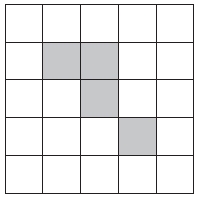
The existing shaded squares form a diagonal-like pattern on the 4×4 grid: row 1 columns 1 and 3, row 2 columns 2 and 4, row 3 columns 1 and 3, row 4 column 2.
Look for a possible line of symmetry. A vertical line between columns 2 and 3 would require column 1 ↔ column 4 and column 2 ↔ column 3.
Check: row 1 col 1 ↔ row 1 col 4 (col 4 not shaded), row 1 col 3 ↔ row 1 col 2 (col 2 not shaded). So vertical symmetry would need too many extra squares.
Try a horizontal line between rows 2 and 3: row 1 ↔ row 4, row 2 ↔ row 3. Row 1 has cols 1,3 shaded; row 4 has col 2. Row 2 has cols 2,4; row 3 has cols 1,3. This doesn't match either.
Try the leading diagonal (top-left to bottom-right): cell (r,c) reflects to (c,r). Currently shaded: (1,1)→(1,1)✓, (1,3)→(3,1)✓, (2,2)→(2,2)✓, (2,4)→(4,2)✓, (3,1)→(1,3)✓, (3,3)→(3,3)✓, (4,2)→(2,4)✓. All existing cells are symmetric about the leading diagonal.
The pattern already has diagonal symmetry with these 7 cells. But we need to shade one more — shade (4,4) to add a symmetric pair (4,4)→(4,4) on the diagonal, preserving symmetry. Alternatively, shading any cell whose diagonal partner is also being added works.
Shade row 4, column 4. The pattern now has a line of symmetry along the leading diagonal.
Answer: Shade the square at row 4, column 4. The completed pattern has one line of symmetry along the leading diagonal (top-left to bottom-right).
(b)
The existing shaded squares are: row 1 columns 1 and 3, row 2 columns 2 and 4, row 3 columns 1 and 3, row 4 column 4.
For rotational symmetry of order 2, the pattern must map to itself under 180° rotation about the centre (2.5, 2.5). Under this rotation (r,c) → (5−r, 5−c).
The only unpaired cell is (1,3) whose partner is (4,2). Shade row 4, column 2.
Now every shaded cell's 180° image is also shaded, giving rotational symmetry of order 2.
Answer: Shade the square at row 4, column 2. The completed pattern has rotational symmetry of order 2.
4.2 marks
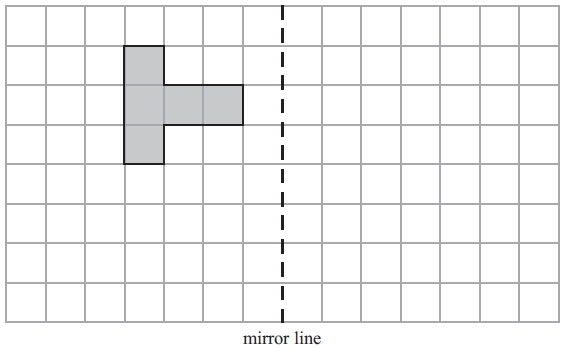
Reflect the shaded shape in the mirror line.
Worked solution
The original shaded shape is to the left of the vertical mirror line. It is an irregular stepped/arrow-like polygon made up of grid squares.
For a vertical mirror line, each square that is d columns to the left of the mirror line reflects to d columns to the right, staying in the same row.
Reflect each column of shaded squares: the column closest to the mirror line maps to the column immediately on the other side, and so on outward.
Draw the reflected shape on the right side of the mirror line. It is a horizontally flipped copy of the original.
Answer: The reflected shape appears on the right side of the vertical mirror line, as a left-right mirror image of the original stepped shape. Each shaded square keeps its row but moves to the corresponding column on the opposite side of the mirror line.
5.1 mark
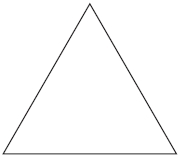
Here is an equilateral triangle.
Write down the order of rotational symmetry of the triangle.
Worked solution
An equilateral triangle has all three sides equal and all three angles equal (60°).
Rotational symmetry means the number of positions in which the shape looks exactly the same during a full 360° turn.
An equilateral triangle looks the same after rotations of 120°, 240°, and 360°. That gives 3 positions.
Answer: 3
6.2 marks(a)
Reflect the shaded shape in the mirror line.
(b)
Reflect the shaded shape in the mirror line.
Worked solution
(a)
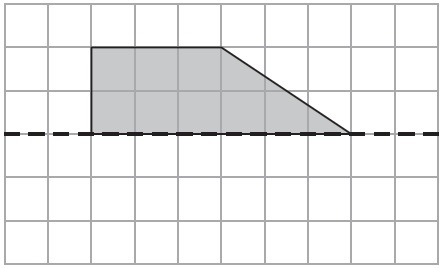
The shaded right-angled triangle is above the horizontal mirror line, in the upper-left area of the grid.
Identify the vertices of the triangle at grid intersections. From the diagram the triangle has vertices approximately at (0, 1), (0, 4) and (4, 1), where the mirror line is at y = 1 (the horizontal dashed line running across the middle).
Reflect each vertex in the horizontal mirror line: a point at distance d above the line maps to distance d below it, keeping its x-coordinate.
Plot the reflected vertices below the mirror line and connect them to form the reflected triangle.
Answer: The reflected right-angled triangle appears below the horizontal mirror line, flipped vertically. Each vertex is the same perpendicular distance below the mirror line as the original vertex was above it.
(b)
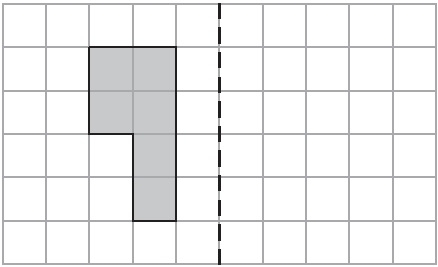
The shaded L-shape is to the left of the vertical mirror line.
Identify the vertices/squares of the L-shape at grid positions. The shape is approximately 2 columns wide and 4 rows tall with a rectangular notch removed from the lower-left.
Reflect each square in the vertical mirror line: a square that is d columns to the left of the line maps to d columns to the right, staying in the same row.
Shade the reflected squares to the right of the mirror line to produce a horizontally flipped L-shape.
Answer: The reflected L-shape appears to the right of the vertical mirror line, as a left-right mirror image. The notch that was in the lower-left of the original appears in the lower-right of the reflection.
7.2 marks
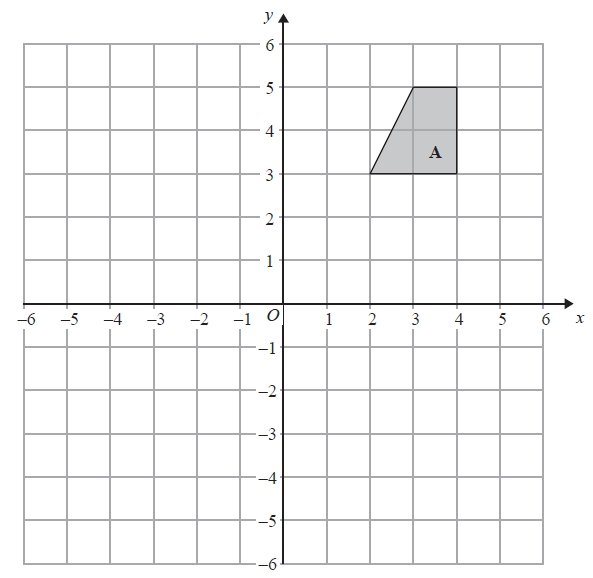
On the grid, rotate shape A 180° about the point (1, 1).
Worked solution
Shape A is a quadrilateral in the first quadrant with vertices at approximately (1, 1), (3, 1), (4, 3) and (1, 3).
To rotate 180° about the point (1, 1), use the rule: each point (x, y) maps to (2·1 − x, 2·1 − y) = (2 − x, 2 − y).
The rotated shape has vertices at (1, 1), (−1, 1), (−2, −1) and (1, −1). It sits in the second/third quadrant region, below and to the left of the centre of rotation.
Plot these four vertices on the coordinate grid and connect them in order to draw the rotated shape.
Answer: The rotated shape has vertices at (1, 1), (−1, 1), (−2, −1) and (1, −1).
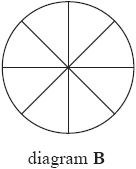
8.2 marks(a)(i)
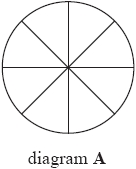
Shade 4 sectors on diagram A so that it has rotational symmetry of order 4.
(ii)
Shade 4 sectors on diagram B so that it has rotational symmetry of order 2.
Worked solution
(a)(i)
The circle is divided into 8 equal sectors, numbered 1–8 going around.
Rotational symmetry of order 4 means the pattern repeats every 90° (every 2 sectors).
Shade every other sector: for example, shade sectors 1, 3, 5 and 7 (i.e. alternate sectors). This gives a pattern that maps to itself after 90°, 180°, 270° and 360° rotations.
Answer: Shade four alternate sectors (e.g. sectors 1, 3, 5 and 7). The pattern has rotational symmetry of order 4.
(a)(ii)
The circle is again divided into 8 equal sectors.
Rotational symmetry of order 2 means the pattern repeats every 180° (every 4 sectors) but not every 90°.
Shade two adjacent sectors and the two sectors directly opposite them (4 sectors apart). For example, shade sectors 1, 2, 5 and 6.
Check: rotating 180° maps sector 1→5, 2→6, 5→1, 6→2 — the pattern is preserved. Rotating 90° maps sector 1→3 (unshaded), so the order is exactly 2, not 4.
Answer: Shade two adjacent sectors and their opposite pair (e.g. sectors 1, 2, 5 and 6). The pattern has rotational symmetry of order 2 but not order 4.
Area and Perimeter of Rectangles and Triangles
8 questions
Things to remember
Area of a rectangle = base x height
Area of a triangle = \(\frac{1}{2}\) x base x height
The perimeter is the distance around the outside of shape
1.2 marks
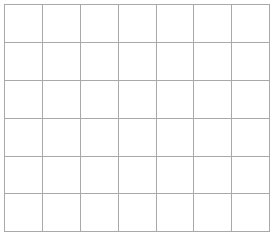
On the centimetre grid, draw a rectangle with an area of \(12 \text{ cm}^2\).
Worked solution
We need a rectangle with an area of \(12 \text{ cm}^2\).
Area of a rectangle = base \(\times\) height.
Find two whole numbers that multiply to give 12: \(3 \times 4 = 12\), or \(2 \times 6 = 12\), or \(1 \times 12 = 12\).
Draw a rectangle on the grid, for example 3 cm by 4 cm (3 squares wide and 4 squares tall).
Answer: Any rectangle with area \(12 \text{ cm}^2\), e.g. \(3 \text{ cm} \times 4 \text{ cm}\), \(2 \text{ cm} \times 6 \text{ cm}\), or \(1 \text{ cm} \times 12 \text{ cm}\)
2.2 marks
On the grid of centimetre squares, draw a rectangle with a perimeter of 10 cm.
Worked solution
We need a rectangle with a perimeter of 10 cm.
Perimeter of a rectangle = \(2 \times (\text{length} + \text{width})\).
So \(\text{length} + \text{width} = 10 \div 2 = 5\).
Find two whole numbers that add to 5: \(1 + 4 = 5\), or \(2 + 3 = 5\).
Draw a rectangle on the grid, for example 4 cm by 1 cm, or 3 cm by 2 cm.
Answer: Any rectangle with perimeter 10 cm, e.g. \(4 \text{ cm} \times 1 \text{ cm}\) or \(3 \text{ cm} \times 2 \text{ cm}\)
3.2 marks
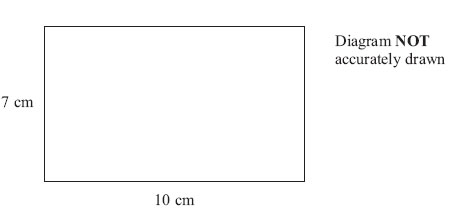
Here is a rectangle. Work out the area of this rectangle.
Worked solution
The rectangle has base 10 cm and height 7 cm.
Area of a rectangle = base \(\times\) height.
Area = \(10 \times 7 = 70\).
Answer: \(70 \text{ cm}^2\)
4.2 marks
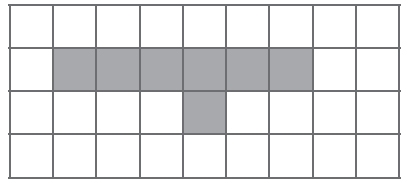
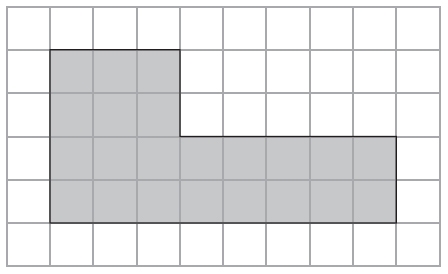
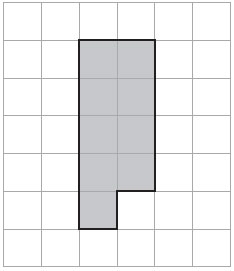
The shaded shape is drawn on a grid of centimetre squares.
(a)
Find the perimeter of the shaded shape.
(b)
Find the area of the shaded shape.
Worked solution
(a)
Count the distance around the outside of the L-shaped figure on the centimetre grid.
Trace the boundary of the L-shape, counting each centimetre edge.
The perimeter is the total distance around the outside of the shaded shape.
Perimeter = 18 cm.
Answer: 18 cm
(b)
Count the number of complete centimetre squares inside the shaded L-shape.
Area = 14 \(\text{cm}^2\).
Answer: \(14 \text{ cm}^2\)
5.3 marks
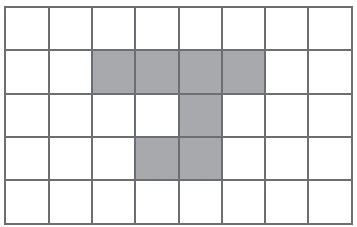
The shaded shape is drawn on a grid of centimetre squares.
(a)
Find the perimeter of the shaded shape.
(b)
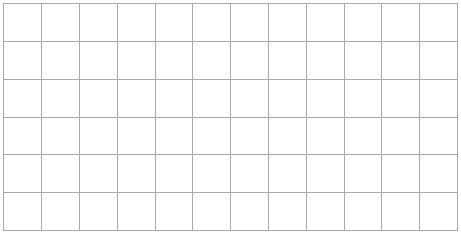
On the grid below, draw a square with the same area as the shaded shape.
Worked solution
(a)
Trace around the outside of the shaded shape on the centimetre grid, counting each centimetre edge.
Perimeter = 14 cm.
Answer: 14 cm
(b)
First count the area of the shaded shape: 9 \(\text{cm}^2\).
We need a square with the same area, i.e. \(9 \text{ cm}^2\).
Side of the square = \(\sqrt{9} = 3\) cm.
Draw a 3 cm \(\times\) 3 cm square on the grid.
Answer: A \(3 \text{ cm} \times 3 \text{ cm}\) square
6.4 marks
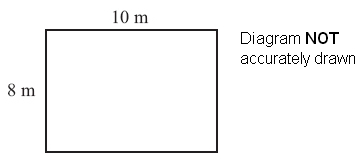
Dilys buys a new house. She wants to have a lawn in the back garden. The lawn is going to be in the shape of a rectangle.
The lawn will have a length of 10 m. The lawn will have a width of 8 m. Dilys wants to buy edging strip for her lawn. The length of the edging strip needs to be equal to the perimeter of her lawn. Edging strip costs \(\pounds 1.50\) per metre. What is the total cost of the edging strip?
Worked solution
The lawn is a rectangle with length 10 m and width 8 m.
Count each value: 1 appears 1 time, 2 appears 4 times, 3 appears 1 time, 4 appears 2 times, 5 appears 1 time, 6 appears 1 time, 7 appears 1 time.
The mode is the most frequent value. 2 appears the most (4 times).
Answer: 2
7.4 marks
Jalin wrote down the ages, in years, of seven of his relatives.
45, 38, 43, 43, 39, 40, 39
(a)
Find the median age.
(b)
Work out the range of the ages.
(c)
Work out the mean age.
Worked solution
(a)
Find the median age of: 45, 38, 43, 43, 39, 40, 39.
Put in order: 38, 39, 39, 40, 43, 43, 45.
There are 7 values (odd count), so the median is the 4th value.
Median = 40.
Answer: 40
(b)
Find the range of: 45, 38, 43, 43, 39, 40, 39.
Maximum = 45, Minimum = 38.
Range \(= 45 - 38 = 7\).
Answer: 7
(c)
Find the mean age of: 45, 38, 43, 43, 39, 40, 39.
Sum: \(45 + 38 + 43 + 43 + 39 + 40 + 39 = 287\).
Count: 7 values.
Mean \(= 287 \div 7 = 41\).
Answer: 41
Tally Charts and Bar Graphs
5 questions
Things to remember
The fifth tally mark should make a gate – this makes it easier to count the tally as you can count up in 5s.
Frequency means total.
If you are drawing a bar chart, the axes must be labelled.
1.7 marks
Ray and Clare are pupils at different schools. They each did an investigation into their teachers' favourite colours. Here is Ray's bar chart of his teachers' favourite colours.
(a)
Write down two things that are wrong with Ray's bar chart.
Clare drew a bar chart of her teachers' favourite colours. Part of her bar chart is shown below.
4 teachers said that Yellow was their favourite colour. 2 teachers said that Green was their favourite colour.
(b)
Complete Clare's bar chart.
(c)
Which colour was the mode for the teachers that Clare asked?
(d)
Work out the number of teachers Clare asked.
(e)
Write down the fraction of the number of teachers that Clare asked who said Red was their favourite colour.
Worked solution
(a)
Answer: 1. The bar chart has no title. 2. The bars are different widths (or: there are no gaps between the bars).
(b)
Answer: Draw a bar for Yellow reaching 4 on the frequency axis and a bar for Green reaching 2 on the frequency axis.
(c)
Answer: Blue
(d)
3 + 5 + 4 + 2 = 14
Answer: 14
(e)
Answer: 3/14
2.7 marks
A shop has a sale. The bar chart shows some information about the sale.
The normal price of a vacuum cleaner is £80. The sale price of a vacuum cleaner is £60. The price of a vacuum cleaner is reduced from £80 to £60.
(a)
Find the reduction in the price of the iron.
(b)
Which two items have the same sale price?
(c)
Which item has the greatest reduction in price?
Mixer
Fryer
Normal price
£90
Normal price
£85
Sale price
£70
Sale price
£70
(d)
Complete the bar chart for the mixer and the fryer.
Worked solution
(a)
Answer: £10
(b)
Answer: Vacuum cleaner and Microwave
(c)
Answer: Microwave
(d)
Mixer: normal price £90 - sale price £70 = £20 reduction. Fryer: normal price £85 - sale price £70 = £15 reduction.
Answer: Mixer: reduction bar drawn to £20, sale price bar drawn to £70. Fryer: reduction bar drawn to £15, sale price bar drawn to £70.
3.5 marks
Daniel carried out a survey of his friends' favourite flavour of crisps. Here are his results.
Plain
Chicken
Bovril
Salt & Vinegar
Plain
Salt & Vinegar
Plain
Chicken
Plain
Bovril
Plain
Chicken
Bovril
Salt & Vinegar
Bovril
Bovril
Plain
Plain
Salt & Vinegar
Plain
(a)
Complete the table to show Daniel's results.
Flavour of crisps
Tally
Frequency
Plain
Chicken
Bovril
Salt & Vinegar
(b)
Write down the number of Daniel's friends whose favourite flavour was Salt & Vinegar.
(c)
Which was the favourite flavour of most of Daniel's friends?
Worked solution
(a)
Answer: Plain (tally: IIII III, frequency: 8); Chicken (tally: III, frequency: 3); Bovril (tally: IIII, frequency: 5); Salt & Vinegar (tally: IIII, frequency: 4)
(b)
Answer: 4
(c)
Answer: Plain
4.5 marks
Here is a bar chart showing the number of hours of TV that Helen and Robin watched last week.
(a)
Write down the number of hours of TV that Helen watched on Monday.
(b)
On which day did Helen and Robin watch the same number of hours of TV?
(c)(i)
Work out the total number of hours of TV that Robin watched on Friday and Saturday.
(ii)
Who watched the greater number of hours of TV on Friday and Saturday? Show your working.
Worked solution
(a)
Answer: 2 hours
(b)
Answer: Sunday
(c_i)
Friday: Robin = 4 hours, Saturday: Robin = 5 hours. 4 + 5 = 9 hours.
Answer: 9 hours
(c_ii)
Robin: Friday (4) + Saturday (5) = 9 hours. Helen: Friday (3) + Saturday (2) = 5 hours. 9 > 5, so Robin watched more.
Answer: Robin
5.3 marks
Heather carried out a survey about her friends' pets. Here are her results.
Cat
Cat
Dog
Hamster
Cat
Dog
Hamster
Cat
Cat
Dog
Hamster
Dog
Hamster
Dog
Fish
Cat
Dog
Fish
Cat
Cat
Complete the table to show Heather's results.
Pet
Tally
Frequency
Cat
Dog
Fish
Hamster
Worked solution
(a)
Answer: Cat (tally: IIII III, frequency: 8); Dog (tally: IIII I, frequency: 6); Fish (tally: II, frequency: 2); Hamster (tally: IIII, frequency: 4)
Pictograms
3 questions
Things to remember
Use the key!
Once you have the number the whole pictures represents you can work out what the picture would be to represent 1 or 2 etc.
1.4 marks
The pictogram shows the numbers of loaves of bread made by Miss Smith, Mr Jones and Mrs Gray.
[Diagram: a pictogram with rows for Miss Smith, Mr Jones, Mrs Gray, Ms Shah, and Mr Khan. The key shows that one rectangle represents 20 loaves of bread. Miss Smith has 3 full rectangles and one half rectangle. Mr Jones has 2 full rectangles and one half rectangle. Mrs Gray has 4 full rectangles and one quarter rectangle. Ms Shah and Mr Khan rows are empty.]
(a)
Write down the number of loaves of bread made by Mr Jones.
(b)
Write down the number of loaves of bread made by Mrs Gray.
Ms Shah made 60 loaves of bread. Mr Khan made 90 loaves of bread.
(c)
Use this information to complete the pictogram.
Worked solution
(a)
Mr Jones has 2 full rectangles and 1 half rectangle. 2 × 20 = 40, half rectangle = 10. Total = 40 + 10 = 50 loaves.
Answer: 50
(b)
Mrs Gray has 4 full rectangles and 1 half rectangle. 4 × 20 = 80, half rectangle = 10. Total = 80 + 10 = 90 loaves.
Answer: 90
(c)
Ms Shah made 60 loaves: 60 ÷ 20 = 3 full rectangles. Mr Khan made 90 loaves: 90 ÷ 20 = 4.5, so 4 full rectangles and 1 half rectangle.
Answer: Ms Shah: 3 full rectangles (3 × 20 = 60). Mr Khan: 4 full rectangles and 1 half rectangle (4 × 20 + 10 = 90).
2.4 marks
The pictogram gives information about the number of goals scored in a local football league in each of 3 weeks.
(a)
Find the number of goals scored in the first week.
(b)
Find the number of goals scored in the third week.
8 goals were scored in the fourth week. 5 goals were scored in the fifth week.
(c)
Complete the pictogram.
Worked solution
(a)
First week has 3 full footballs and 1 half football. 3 × 4 = 12, half football = 2. Total = 12 + 2 = 14 goals.
Answer: 14
(b)
Third week has 2 full footballs and 1 half football. 2 × 4 = 8, half football = 2. Total = 8 + 2 = 10 goals.
Answer: 10
(c)
Fourth week: 8 goals, 8 ÷ 4 = 2 full footballs. Fifth week: 5 goals, 5 ÷ 4 = 1.25, so 1 full football and 1 quarter football.
Answer: Fourth week: 2 full footballs (2 × 4 = 8). Fifth week: 1 full football and 1 quarter football (1 × 4 + 1 = 5).
3.3 marks
Sharif buys some fruit. The pictogram shows information about the number of apples and the number of oranges he buys.
(a)
Write down the number of apples he buys.
(b)
Write down the number of oranges he buys.
Sharif buys 12 peaches.
(c)
Use this information to complete the pictogram.
Worked solution
(a)
Apples row has 3 full rectangles and 1 half rectangle. 3 × 8 = 24, half rectangle = 4. Total = 24 + 4 = 28 apples.
Answer: 28
(b)
Oranges row has 2 full rectangles and 1 half rectangle. 2 × 8 = 16, half rectangle = 4. Total = 16 + 4 = 20 oranges.
Answer: 20
(c)
Sharif buys 12 peaches. 12 ÷ 8 = 1.5, so 1 full rectangle and 1 half rectangle.
Answer: Peaches: 1 full rectangle and 1 half rectangle (1 × 8 + 4 = 12).
Probability
8 questions
Things to remember
Probability can be expressed as a fraction, decimal or percentage. Do not write it as a ratio.
All probabilities of an event will add up to 1.
1.2 marks
Draw a circle around the word, or words, which best describe the following possibilities.
(a)
It will rain in Manchester next September.
impossible
unlikely
even chance
likely
certain
(b)
The next baby to be born in London will be a girl.
impossible
unlikely
even chance
likely
certain
Worked solution
(a)
Rain in Manchester in September is something that happens regularly, so it is likely.
Answer: likely
(b)
A baby is roughly equally likely to be a boy or a girl, so there is an even chance.
Answer: even chance
2.3 marks
On the probability scale below, mark
(i)
with the letter S, the probability that it will snow in London in June,
(ii)
with the letter H, the probability that when a fair coin is thrown once it comes down heads,
(iii)
with the letter M, the probability that it will rain in Manchester next year.
[Diagram: a probability scale from 0 to 1]
Worked solution
(i)
Snow in London in June is extremely unlikely; it is virtually impossible.
Place S at or very near 0 on the probability scale.
Answer: S is placed at 0 (or just above 0)
(ii)
A fair coin has two equally likely outcomes, so \(P(\text{heads}) = \frac{1}{2}\).
Place H at the midpoint of the scale, i.e. at \(\frac{1}{2}\).
Answer: H is placed at \(\frac{1}{2}\)
(iii)
Rain in Manchester over a whole year is virtually certain.
Place M at or very near 1 on the probability scale.
Answer: M is placed at 1 (or just below 1)
3.1 mark
Kevin buys one raffle ticket.
A total of 350 raffle tickets are sold.
One of these tickets will win the raffle.
Each ticket has an equal chance of winning the raffle.
Write down the probability that Kevin's ticket will win the raffle.
Worked solution
Kevin has 1 ticket out of 350 tickets in total.
Each ticket is equally likely to win.
\(P(\text{Kevin wins}) = \frac{1}{350}\).
Answer: \(\frac{1}{350}\)
4.2 marks
The diagram shows a fair spinner in the shape of a rectangular octagon.
[Diagram: a regular octagonal spinner divided into 8 equal sections labelled A, A, A, B, B, B, C, C]
The spinner can land on A or B or C. Marc spins the spinner.
Write down the probability that the spinner will land on A.
Worked solution
The spinner is a regular octagon divided into 8 equal sections.
3 sections are labelled A, 3 are labelled B, and 2 are labelled C.
\(P(A) = \frac{3}{8}\).
Answer: \(\frac{3}{8}\)
5.2 marks
A bag contains some beads which are red or green or blue or yellow.
The table shows the number of beads of each colour.
Colour
Red
Green
Blue
Yellow
Number of beads
3
2
5
2
Samire takes a bead at random from the bag.
Write down the probability that she takes a blue bead.
Worked solution
Total number of beads \(= 3 + 2 + 5 + 2 = 12\).
Number of blue beads \(= 5\).
\(P(\text{blue}) = \frac{5}{12}\).
Answer: \(\frac{5}{12}\)
6.2 marks
Richard has a box of toy cars.
Each car is red or blue or white.
3 of the cars are red. 4 of the cars are blue. 2 of the cars are white.
Richard chooses one car at random from the box.
Write down the probability that Richard will choose a blue car.
Worked solution
Total number of cars \(= 3 + 4 + 2 = 9\).
Number of blue cars \(= 4\).
\(P(\text{blue}) = \frac{4}{9}\).
Answer: \(\frac{4}{9}\)
7.1 mark
A company makes hearing aids.
A hearing aid is chosen at random. The probability that is has a fault is 0.09
Work out the probability that a hearing aid, chosen at random, will not have a fault.
Worked solution
\(P(\text{fault}) = 0.09\).
Using \(P(\text{not A}) = 1 - P(\text{A})\):
\(P(\text{no fault}) = 1 - 0.09 = 0.91\).
Answer: \(0.91\)
8.4 marks
60 British students each visited one foreign country last week.
The two-way table shows some information about these students.
France
Germany
Spain
Total
Female
9
34
Male
15
Total
25
18
60
(a)
Complete the two-way table.
One of these students is picked at random.
(b)
Write down the probability that the student visited Germany last week.
Two of these fractions are equivalent to \(\frac{1}{4}\). Which two fractions?
Worked solution
(a)
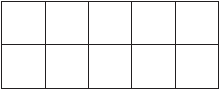
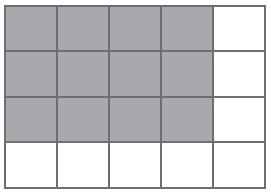
The shape is a 2 \(\times\) 5 grid, so it has 10 equal squares.
4 squares are shaded.
Fraction shaded \(= \frac{4}{10}\).
Answer: \(\frac{4}{10}\)
(b)
The shape is a 2 \(\times\) 5 grid, so it has 10 equal squares.
\(\frac{1}{5}\) of 10 \(= 10 \div 5 = 2\).
Shade any 2 of the 10 squares.
Answer: 2 squares shaded out of 10
(c)
Simplify each fraction to see which equal \(\frac{1}{4}\).
\(\frac{3}{10}\): HCF of 3 and 10 is 1, so it is already in simplest form. Not \(\frac{1}{4}\).
\(\frac{2}{8}\): HCF of 2 and 8 is 2. \(\frac{2 \div 2}{8 \div 2} = \frac{1}{4}\). This is equivalent.
\(\frac{4}{12}\): HCF of 4 and 12 is 4. \(\frac{4 \div 4}{12 \div 4} = \frac{1}{3}\). Not \(\frac{1}{4}\).
\(\frac{12}{40}\): HCF of 12 and 40 is 4. \(\frac{12 \div 4}{40 \div 4} = \frac{3}{10}\). Not \(\frac{1}{4}\).
\(\frac{5}{20}\): HCF of 5 and 20 is 5. \(\frac{5 \div 5}{20 \div 5} = \frac{1}{4}\). This is equivalent.
Answer: \(\frac{2}{8}\) and \(\frac{5}{20}\)
5.3 marks
Here are two fractions.
\(\frac{3}{5}\) \(\frac{7}{9}\)
Which of these fractions has a value closer to \(\frac{1}{2}\)?
You must show clearly how you get your answer.
Worked solution
Find how far each fraction is from \(\frac{1}{2}\).
For \(\frac{3}{5}\): convert to the same denominator as \(\frac{1}{2}\). \(\frac{1}{2} = \frac{5}{10}\) and \(\frac{3}{5} = \frac{6}{10}\). Difference \(= \frac{6}{10} - \frac{5}{10} = \frac{1}{10}\).
For \(\frac{7}{9}\): \(\frac{1}{2} = \frac{9}{18}\) and \(\frac{7}{9} = \frac{14}{18}\). Difference \(= \frac{14}{18} - \frac{9}{18} = \frac{5}{18}\).
Compare: \(\frac{1}{10} = \frac{9}{90}\) and \(\frac{5}{18} = \frac{25}{90}\).
Since \(\frac{9}{90} < \frac{25}{90}\), \(\frac{3}{5}\) is closer to \(\frac{1}{2}\).
Answer: \(\frac{3}{5}\)
6.2 marks
Why does \(\frac{1}{4} = \frac{2}{8}\)?
Worked solution
Multiplying both the numerator and denominator of \(\frac{1}{4}\) by 2 gives \(\frac{1 \times 2}{4 \times 2} = \frac{2}{8}\).
Equivalently, dividing both the numerator and denominator of \(\frac{2}{8}\) by their HCF of 2 gives \(\frac{2 \div 2}{8 \div 2} = \frac{1}{4}\).
Since multiplying (or dividing) both the numerator and denominator by the same number does not change the value of the fraction, \(\frac{1}{4} = \frac{2}{8}\).
Answer: Because \(\frac{1 \times 2}{4 \times 2} = \frac{2}{8}\); multiplying the numerator and denominator by the same number gives an equivalent fraction.
7.3 marks(a)
What fraction of this shape is shaded?
Write your fraction in its simplest form.
(b)
Shade \(\frac{3}{4}\) of this shape.
Worked solution
(a)
The shape is a 2 \(\times\) 5 grid, so it has 10 equal squares.
6 squares are shaded, so the fraction shaded is \(\frac{6}{10}\).
Simplify: HCF of 6 and 10 is 2. \(\frac{6 \div 2}{10 \div 2} = \frac{3}{5}\).
Answer: \(\frac{3}{5}\)
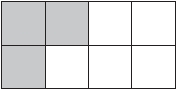
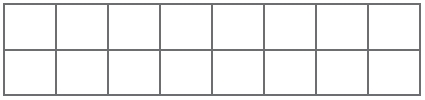
(b)
The shape is a 2 \(\times\) 4 grid, so it has 8 equal squares.